Showing posts with label Lyricism. Show all posts

Sunday, October 08, 2023

 "Now you're gone, there's nothing left to go on, to go on..."

In May 2017, I took a night bus to Ghent with the grand ambition of writing a song. I had written one just a few days before on my guitar. I had been keen to incorporate a term that we used at the hostel, so I called it Check Out. The lyrics cited the well-honed seduction techniques from our local Lothario: "Leave tonight with glow-sticks in your shoes, it's a sign you're just another conquest, just another conquest..." It only really meant something to those who were there.

The idea of songwriting tourism came about when I reflected upon one former colleague who locked herself up in an Amsterdam apartment to write an EP. I knew I couldn't do anything like that, I'm too much of a tourist to refrain from going to the castles and the op shops. I need to go to the record shops and hassle the record store owners about the local scene in the 1980s. I need to go to the clothing shops and Shazam every song. I talk to too many people. I make too many friends. No way could a song materialise from that...

I did try on that trip to Ghent though. Between the frantic tourism, I went from coffee shop to coffee shop, writing Pat Pattison-style boxes containing lyrical narratives in my flimsy cahier. Nothing materialised. It wasn't until I came upon Le Bal Infernal, a used book cafe, when something changed. I sat in the corridor, watching a silent film flicker on the creamy stone walls, probably creating a fire hazard. An inter-title flashed up and stung me: "My heart's broken. I must be alone with my thoughts." 

Making sense of your false concepts...

I ordered at the bar. I sat down with a mocha and Trust Accounts arrived.

I worked out the chords and keyed in a primitive melody on Caustic, a synthy app on my phone. I wrote lyrics down in pencil, fearing a mistake but it fell out intact. The people on the next table asked me, "What are you doing?!" I laughed. You would have thought I would feel embarrassed or annoyed but I felt totally elated. Randoms witnessed this outpouring of frantic MIDI coding and my god, I had never identified as a songwriter, but these strangers just saw me writing a song.

Certain lines of Trust Accounts felt like a Jessie Ware song to me: "Why must we act as if this is forever when love expires at the end of the night? Why must I care and hope and wish whenever you say that we can talk and share despite..." It wasn't about any one person, it was about a pattern that rolls on in perpetuity: men demanding trust in an intrusive way.

My version of Trust Accounts is not the definitive version. My friend, Marcella Wright of the synth duo Silent Income recorded a cover of it. She sends me videos of her singing it on stage in Melbourne: "Demand accounts, you can talk, you can trust me..." If it wasn't for her, Trust Accounts would have lived and died as an unheard scrappy demo, but she arranged it and transformed it, giving it this beauty and iridescence.

The lyrics still sting, but I love that. I love how it honoured, and still honours, my truth.

Cassettes & Chocolate Milk: Consequential Lyrics Fan Podcast #76
Bronski Beat - Smalltown Boy (David M. Green's VHS Revue)
Faunts - M4, Pt. 2 (Word Tweak's Substack)
Brand New - Seventy Times 7 (Jessa Stephens' My Girlfriend Dolly)
New Order - Subculture (IJ Wilson's Halloween Listening Party on FOTW Radio)
Echo and the Bunnymen - A Promise (Mark Silver's Twitter)
Sparks - Equator (Rebecca Sheedy's Mild Scribbling)
Paul Simon - The Obvious Child (Shot97's YouTube)
Belle and Sebastian - Desperation Made a Fool of Me (Teatles' Twitter)
Pink Floyd - Time (David M. Green's VHS Revue)
Bloc Party - Plans (Sharronswims' Instagram)

Download (154.2MB)

Explore C&CM Podcasts 1-75 here

More about Consequential Lyrics

Saturday, July 08, 2023

"The pureness and simplicity must come across so people can hear the human part of the song. That is everything."

I came across that quote and I immediately thought of the bonus mini-zine that Teatles made called Beautiful Beatle Moments. It features contributions by tweet to the question: "Does anyone have a favourite moment in a Beatles song? A second or two where it all gets perfect?"

The quotes are abundant and anonymous: "The pause in the middle of She Came in Through the Bathroom Window, just before the "She said she'd always been a dancer." Each moment is spliced into a micromoment, conveyed in only a handful of words but it takes you straight to a heart-buzzing vocal take or an instrumental that makes you feel vast levels of love and gratitude. Intense emotions are cited, "John's high-pitched desperate 'pleeease' at the end of Don't Let Me Down."

In any Beatle-related conversation, it is common to bandy around the term "perfect". It's convenient for the hyperbolic gushy types like myself, but it's also helpful to convey a certain sense of gratitude that everything managed to transpire as it did. It's also helpful that to have community of people who can identify these "moving" micromoments of happiness, something barely detectable that somehow reveal the humanness, the laughter and mistakes of this band: "George fudging the solo in All You Need is Love - I know it was live. All these add to their greatness rather than detract from it."

Others run towards the raw expression and I can feel the beauty of these moments too: "Oh, how could I forget this? John baring his soul and almost sobbing the vocals, five years prior to the Plastic Ono Band album, "But it's my pride, yes it yes, yes it is, yes it is." It's beautiful to recognise something that could have been characterised as a therapeutic release, despite the evident levels of pain. We like to think we know what John had been going through and detecting these small dimensions of grief help us in some way. They help, because we miss him. It also provides a small hope that this music was cathartic for him too.

It's strange but that kind of vulnerability was mentioned only today, when I watched Paul analyse his photographs for the NPG's exhibition, Paul McCartney, Photographs 1963–64: Eyes of the Storm. Paul looked up at his photograph of John sitting in the back seat of a car, his hand folded to cover his mouth. "I forgot how he used to do that all the time..." I recognised that self-soothing gesture within myself, as a former thumb-sucker. You cover up on your month in moments of stress and you do so without even thinking about it, and then you realise you're doing it all the time.

Got to be good looking 'cause he's so hard to see

In Music and Imagination, Aaron Copland wrote about how difficult it was to seize the musical experience and hold it. "Unlike that moment in a film when a still shot suddenly immobilises a complete scene, a single musical moment immobilised makes audible only one chord, which in itself is comparatively meaningless." It might be easier to look at Paul's photograph of John and extrapolate the character of a man we feel like we know, but it's still fun to challenge Copland. We're each attempting attempt to seize the musical experience, as fleeting and granular as it is. The joy is in the attempt.

Cassettes & Chocolate Milk: Early 90s Pop Podcast #73
The Adventures of Stevie V - Dirty Cash (Money Talks) (Sold Out 7 Inch Mix)
Ace of Base - Happy Nation
Split Mirrors - The Right Time
Peter Gabriel - Digging in the Dirt
Oingo Boingo - Dream Somehow
Leevi and the Leavings - Turkmenialainen tyttöystävä
The Beloved - Time After Time
C+C Music Factory - Gonna Make You Sweat (Everybody Dance Now)

Download (87.8 MB)

Explore C&CM Podcasts 1-72 here

Sunday, March 13, 2016

The Milk Diaries: Leftover Love

“I succeed very well, by not looking at the world around
By not looking at myself
Going on, moving, constantly.”
Dyva - Leftover Love

I felt a desperate need to listen to this song, lying across some seats on a local bus to Cirencester. It was some years ago and I was with my family. We were all stuck in traffic and I felt lousy. I knew only emotional early Italo Disco would assist with whatever ailed me. I sought out the bouncy bass and cloudy vocals and I wailed along under my breath:

“People can’t invent,
Their lovers and friends,
It’s life which gives these
And also takes them away sometimes.”

It’s not the most articulate of lyrics, but it reminded me of a friend who once described the appeal of Italo Disco. He said it was the language barrier which makes for more pure, expressive lyricism. It was an insight that, for me, added so much to a genre that is so commonly dismissed as disposable. Leftover Love is lyrically clunky, but it captures a desperate level of sincerity:

“I want to say yes,
Want to say yes to life!”

It's been a long time since that bus ride in Cirencester, but I occasionally think of Leftover Love and how meaningful lyrics needn't be particularly poetic or articulate. There can be something in the simplicity of expression which can make a song quite profound, even though it is hard to believe such meaning was ever really intended..

Thursday, March 03, 2016

The Milk Diaries: Desire

Is there such a thing as a musical coincidence when you talk about music all the time? Probably not, but then it was damn weird when my songwriting teacher brought up Glen Campbell's Wichita Lineman in class some time ago. My friend and I had only been talking about that song the night before and I don't believe I've ever talked about that song with anyone, ever.

The class analysed the imagery of the lyrics: lonely image of a heartbroken man, working on the telegraph poles, longing for love and a vacation. We dwelled on the lines, "And I need you more than I want you and I want you for all time..." Some classmates felt put off by the expression, dismissing it as easy and simplistic, yet I felt drawn to it for some reason.

It reminded me Craig Schuftan and his writing on pop, how desire and want is at the centre of pop lyricism. Even now, to vaguely recall pop titles like I Want to Hold Your Hand, I Only Want to be With You or I Want to be Your Dog reflect an adolescent kind of yearning that could be easily dismissed. To want a thing in pop is to echo a frustration but also a very physical desire.

The sentiment of want can be compared with that of need. It's a similar kind of thing, but you feel that there is greater sense of urgency involved: Need You Tonight, I Need You, All I Need is You, Saying that, the insistent quality of need tends to come across as a desperate, trumped up hypberole. It's saying that you need another person in order to exist and that is a bit absurd.

For the practising pop songwriter, to choose between want and need in a lyric is embarrassing. Perhaps these are overused pop cliches or else they denote an overblown sense of devotion that borders on insincere. Saying that, it is still these kinds of lyrics which ring in our ear when we consider expressions of desire in pop. They're simplistic things but they provide a shortform way to articulate love and lust.

It's convenient thing, especially when you stumble upon a line you love. You can say: "It's us."

Tuesday, March 01, 2016

The Milk Diaries: Denial

It was a cover Ace of Base never wanted to record, but Don't Turn Around exists as a visceral feature of their 1993 debut, The Sign (or Happy Nation, in the US). Originally recorded by Aswad in 1988, I must have listened to their synthy re-interpretation hundreds, if thousands of times since I bought it as my first CD. However, it was very only recently that it struck me why Don't Turn Around was such a potent song: its lyrics contain ineffectual statements which elude to an emotional recovery that is unlikely to take place anytime soon.

The opening line, delivered in strained spoken word says it all: "I will survive without you..." There is a synthesized rip, the kind of sound which would plausibly represent the sound of a heart being torn apart. The genius of the song does not simply exist in its instrumentation, the reggae riddim and B minor key signature, I believe it is in the lyrical treatment of vagueness and specificity, there is something heartbreaking in its depiction of both hope and denial.

Everything in the verses suggest that emotional investment is minimal: she will not campaign for reconsideration ("If you wanna leave, I won't beg you to stay"). She goes on to claim indifference about the dismantled relationship ("I won't miss your arms around me, holding me tight"). The future tense provides a clue that true recovery will take place in time ("And if you ever think about me, just know that I'll be alright"). The truth of her heartbreak is only ever revealed in the chorus:

"Don't turn around, cause you're gonna see my heart breaking,
Don't turn around, cause you're gonna see me cry,
Just walk away, it's tearing me apart that you're leaving,
I'm letting you go, but I won't let you know."

It is a devastating sentiment and you wonder whether she really does want him to turn around, to look back and acknowledge the breadth of her personal investment. It paints the portrait of a girl who attempts to regain a sense of power and composure at a time when words hold no persuasive currency. The contrast and contradiction leads us to consider whether the declaration in the chorus is designed to be an emotionally manipulative tactic or simply an explanation: please ignore the cold indifference, it is borne of grief.

Sentimentally speaking, Don't Turn Around could be aligned with Gloria Gaynor's I Will Survive. Both songs contain a succession of bold assurances of strength and goals of independence but the difference is that the confidence of I Will Survive suggests that recovery is inevitable. You don't really get that sense in Don't Turn Around, particularly since the Ace of Base version features a unique spoken word bridge from the estranged partner, declaring that pride prevents him from ever looking back.

The song remains preserved and unresolved, existing somewhere between truth and fiction forever and ever. I think that's why I need to pay heed to it. It's a perfect piece of songwriting.

Monday, September 16, 2013

Consequential Lyrics #4: Pet Shop Boys

As soon as I started thinking about the Pet Shop Boys and lyricism, my thoughts instinctively turned to the website 10 Years of Being Boring. It's a relatively old (and surprisingly vast) website that was first created in 2000 and last updated in 2003, but I have never encountered anything like it before or since. I admire its reverence and its ambition to faithfully describe the construction and consequence of this one song, a song the webmaster describes as the most beautiful song ever created.

Even before the site's advent, I knew there was always a certain sanctity that surrounded this song. I recognised it in the hand-written text which featured in the introduction of the promotional video:


It's wistful and poignant, reflecting upon friendship and loss, the passing of time and the dreams of those who are no longer with us. In an interview in 1993, Neil Tennant said that Being Boring was a personal song because it was about an old friend who had died of AIDS: "... and so it's about our lives when we were teenagers and how we moved to London, and I suppose me becoming successful and him becoming ill." According to the webmaster of 10 Years..., Being Boring was Tennant's first autobiographical song and that idea really intrigued me.

How do we properly establish that a song is autobiographical in nature? Does it need to have a certain quality, an alarming degree of personal intimacy? Surely there needs to be some specificity, a plausible link between the artist and the confession? It's always interesting when an artist freely discloses that personal consequence in an interview, as Neil did with the New Musical Express. What's fascinating, in this case, is how that act of disclosure ultimately contributed to the credibility of the Pet Shop Boys, transforming their unique brand of disco into art.

It's always so enjoyable to listen to Neil and Chris discuss their music, as demonstrated by how frequently we watch Pop Art: The Videos with their commentary. It's abundantly clear that it's all been carefully scrutinised in great detail: it's everything from the samples to the orchestration, the artwork and the imagery, not to mention, all those lyrical themes and intended meanings. It's so enormously gratifying to see how much thought went into the construction of this great music and yet, I can't quite understand why I appreciate it so much.

Perhaps a part of it has to do with the fact that so many artists just don't go into that level of detail. Whether it be obtuse lyrics or cagey artists, it's unrealistic to think the listener can always uncover a song's autobiographical relevance to the songwriter. It's a point that is so often demonstrated by friends who are musicians, who go on to confess the meaning of that song after the show is over. They add, "But I can never say that in an interview, I can never tell anyone what that song really means." I suppose that's why the autobiographical song seems so important: we want to feel as if we've been entrusted with a secret.

Consequential Lyrics #4: Pet Shop Boys
Home & Dry
Opportunities (Let's Make Lots of Money)
Can You Forgive Her?
Miracles
Always On My Mind
Numb
The Way It Used To Be
Tonight is Forever

Download (61 MB)

Monday, August 26, 2013

Consequential Lyrics #1: Queen

I have finally come to terms with the idea that I'll never know what Freddie Mercury meant.

I fell in love with Queen as an eight year old and Freddie Mercury still has the honour of being my most important musical influence. Given all the personal meaning I invested in his creative output, I thought that Freddie would think about it in much the same way. However, when it came to talking about his music and lyrics, Freddie was vague. And flippant. Annoyingly vague and flippant. He boasted about the disposability of his music, famously likening his songs to Bic Razors. It was an irksome message: "You listen to it, like it, discard it, then on to the next. Disposable pop."

In his earliest interviews, he spoke of the difficulty and irritation associated with lyric writing. In later interviews, he spoke of the routine nature of creativity, the analogy that struck me most was that making music was much like churning out sausages in a factory. He consistently avoided disclosing any personal meanings and associations, urging listeners to develop their own interpretations. At the same time, there was a tantalising suggestion that there was some autobiographical meaning there: "People are always asking me what my lyrics mean. Well I say what any decent poet would say if you dared ask him to analyse his work: if you see it, darling, then it's there."

I've spent a lot of time with Freddie. I've read a lot of books and listened to a lot of interviews. I have talked to a lot of people about his attitude towards lyricism and musical creativity: from musical collaborators, biographers, documentarians to representatives from Queen Productions. Some fascinating revelations came from that research, one contributor even theorised that Freddie's reluctance to disclose the nature of his creative process was due to a superstition. Apparently, he feared that if he described his working process, he would lose that ability to create... and here I imagined that he just wanted to keep it all to himself, not make his feelings conversational fodder for untrustworthy music journalists.

I was in this never-ending search for this lost sound byte, where Freddie gives up the coy bravado and reveals something consequential. I'd find flecks of honesty here and there, a re-imagining of Freddie pulling up a piano to his bed, to play melodies if inspiration ever struck during the night. Of course there's that immortal anecdote of Crazy Little Thing Called Love being composed in a tub at the Munich Hilton. It was not because it particularly affected my relationship with his music, but I just never bought his dismissive "forget this, it means nothing" routine. Given the passion and complexity of his work and the immense effort it took to create it, I fail to see how he honestly believed his music was disposable.


But perhaps it was just me, perhaps it was just me! Perhaps I had just spent so much time with this music and I had theorised about it so much that I wanted to feel as if he invested something personal in his art. There was always that possibility that he only viewed music as a money-making venture, but I was forever hopeful that he had approached it as a sentimental artist. While everybody else I talked to could accept what he said at face value, it was harder for me to accept that maybe, he just didn't care as much as I did and maybe, just maybe, I didn't know him as well as I thought I did.

Ironically enough, there was once a time when I didn't really care what Freddie thought of his own lyrics. As a teenager, I wrote wildly preposterous online essays interpreting various Queen lyrics. I employed provocative techniques to get readers enraged and engaged. I wanted them to tell me I was wrong: "That was not what Freddie meant!". For me, it was not about being right, as such, it was about motivating listeners to articulate their personal understanding of these songs. The passion and the authority with which readers spoke about his lyricism really inspired me. Even though there was no citations for any of it, I was often moved by the insight and eloquence of these people who took the time to study his music so carefully.

All those essays, that research and production work invariably led to the invention of this series. Consequential Lyrics is a project which celebrates the meanings we independently create, as lovers and listeners of pop. We are naturally pre-disposed to create personal meanings, in such a way that provides comfort, wisdom and insight. For all the songs we do love, it's rare that we get that opportunity to faithfully articulate that significance in a properly ordered way. I suppose this project as an opportunity for you to express those private meanings, to record your voice, describing the significance of those songs in such a way that it legitimises the process of personal identification.

I may never find that sound byte, that phantom interview where Freddie reveals exactly what I want him to reveal. Frustration lies in the fact that nobody really asked the right questions, not the questions I would have wanted to ask, anyway. I comfort myself at the thought that he would have extremely unimpressed at my preposterous suggestions and my tenuous theories, connecting lyrical fragments to a varied succession of internal conflicts. Yet now it doesn't even really matter, I see now that his reluctance inspired to something far more personally meaningful. Whatever his feelings were about his music, life and words, I'm grateful to him for all the love and curiosity he inspired within me.

Consequential Lyrics #1: Queen
The Night Comes Down
The Fairy Feller's Master-Stroke
The March of the Black Queen
In the Lap of the Gods (Revisited)
Spread Your Wings
The Show Must Go On

Download (53.3 MB)

Monday, June 15, 2009

I think we were both a little startled when I said it: I want all your songs to be about me. In that single moment, everything seemed to be drenched in my own despicable vanity. I revealed my addiction to attention, to yearning, to impossibility and the true extent of my selfishness. I so wanted his heart to be wasted on me, even though we were nothing more than just friends.

I will always admire those who have the ability to faithfully describe someone like that: in so few words that it borders on ineffectual, yet once combined with music, becomes so charmed. It also takes a great deal of bravery to make someone distinguishable from any other. At times, it borders on intrusive to know exactly who these songs are about. You are not invited to impose your own lyrical interpretation, because you understand who is the object of the song. Think of Something, In The Lap of the Gods or Songbird. There's no point contemplating that these songs were about anyone aside from Pattie, Mary or Nicole, respectively.

When I write, I do so in such a way that anyone from my past could think it was about them. I would hope there is enough breadth, warmth and ambiguity present to qualify such an assumption. My writing is never about one person specifically, after all, it is a bunch of ripped up photographs of the people I once loved.. and even though I've revealed the true extent of my selfishness, I would still like it if they were flattered by my regard. As vague and ambiguous as it would sometime seem.


The suggestion is clear

Cassettes & Chocolate Milk: Britpop Podcast #13
Arkarna - Rehab
Mood Six - The Voice of Reason
The House of Love - Shine On
Cotton Mather - My Before and After
The Beatles - Free as a Boid
Eugene McGuinness - Monsters Under The Bed
Pulp - Babies
Dogs Die in Hot Cars - Squeeze

Download (29.6 MB)

Tuesday, December 02, 2008

I remember sitting on the front steps of this guy's Art Deco styled, Grey Street apartment. We sat waiting for a taxi together, waiting to get to this party at the Public Offices. I had waited months, years, maybe even decades to be sitting next to this person, waiting for this party. Yet no matter how long I waited, I would still be far too young. Of course, I was in denial of this fact at the time. It only took me two whole years to acknowledge it. Once I did, I dramatically, defiantly and silently declared: if it's because of my age then you're a coward.

When we waited together on these front steps, I was far too anxious to meet his gaze. I would just play with the cuffs of the navy polyester jacket he lent me for the second part of the evening. We were talking about New Order. We would always talk about New Order. He was kind of ashamed of liking Erasure and he knew very little about Depeche Mode. We wouldn't talk about the Cure a lot - although earlier that evening, I acquired the god-fearing audacity to quote the 13th at him: are you seducing or being seduced? To this day, I emphatically insist that the quote was in context, it must have been in context. He must have been flirting with me for me to say something as provocative as that. Surely I wasn't just dreaming of the attraction and rapport? I must have been out of my mind.


Is it really such a sin? Cause if it is, then I'll give in

We were talking about the Reading 3-16 DVD. I laughed at Barney's teleprompter at the front of the stage. "Surely he's been performing these songs for the best part of 20 years, how could he not remember the lyrics of Blue Monday?" He laughed and said that he always felt that Barney was so out of place on stage. He attributed these thoughts to how Barney came to be singer of the band and how Barney tended to have a real lack of showmanship. "It wasn't the place where he was meant to be - he was meant to be an accountant or an architect or something like that. It seems to be a such a mistake."

I knew he was speaking about himself, in some odd way. I didn't have the nerve or the time to ever ask him what he might of meant by that - our maxi taxi was here. He grabbed my hand as we walked to the van and resumed the rest of our evening.

Cassettes & Chocolate Milk: Electro Podcast #9
frYars - Olive Eyes
Piney Gir - Boston
Supersystem - The Lake
Ace of Base - Wave Wet Sand
Erasure - Waiting for the Day
Queen - Action This Day (demo)
Berlin - The Metro
Dr John - New Looks

Download (28.1 MB)

Tuesday, June 10, 2008

What if your perfect verse is just a lie you tell yourself to help you get by?

Only Ben Gibbard could pen a sentiment so romantically fearful. It is a sentiment that touches upon the dreaded possibility of musical and lyrical insincerity. But can your perfect verse be a lie if it holds meaning for you (and perhaps even you alone)? There have to be moments where you feel compelled to push aside the purported intent of the musician and regale in the personal significance of it all... that a song can be so moving that words never seem to do the feelings justice. Even hyperbolic words, italicized and underlined twice.

My brother once said that a song is perfect when you can't imagine how it could have been written. I always thought it was such a poetic statement, I hardly would have expected it from him. I've tended to return to that ideal, particularly when I consider the paradox of the perfect verse. After all, how can you identify the songwriter's true intent if you can't even imagine them sitting down to write a song?

Then again, it might be that very factor which makes those verses perfect. It seems that we can be so far removed from the artist's creative process that we are only left to our own sensibilities to reinterpret their musical scenes and sentiments. So perhaps, it's not necessarily important whether a lovelorn Morrissey ever did kiss anyone under an iron bridge (or ended up with sore lips, for that matter). The perfect nature of the verse is instilled in its capacity to take you somewhere else, whether it be down at the tube station at midnight or a very big house in the country.

With that being said, I hope that when my perfect verse is proved to be a lie, I won't be disappointed. I hope I will always regale in the personal significance of it all and rejoice that something so false could bring about something that really did feel so perfect.

Wednesday, October 24, 2007

Burned with an inferiority complex, lovers of popular music have an overbearing concern to locate content and depth in something that is generally dismissed as inane and shallow. Consequently, analysts look to the “high” cultural terms of literary criticism, political theory and cultural studies to validate and break down musical culture. The chaotic, indeterminate nature of music seeks to highlight that the true value of music cannot found in its meaning, but in its noise. Music writer Simon Reynolds described his own critical experience of pop music to be moments of perplexity, “when the mouth and the mind gape, when you’ve yet to sort out your responses, or get a firm grip on what a group is "about" or "trying to say"". Reminiscent of an illicit love affair, musical pleasure acts an intoxicant, inflaming our passion for love, expression and identity. Synonymous with my faith in love and music, the reasons and motivations behind my passion for the British musical identity are varied and difficult to articulate.

I believe my personal background has a significant role in my fascination with the musical culture of Britain. I first fell in love with music when I was five years old, during a six-month family holiday to England. During our many weekend adventures to historic stately homes, churches and castles, our family consistently listened to four cassette tapes: Erasure, the Carpenters, Milli Vanilli and Cat Stevens. For years to come, I would indulge in the beautiful medieval imagery of Erasure’s album The Innocents in an attempt to recapture memories of the trip that largely remained untapped. Such wistful yearning, homesickness and nostalgia are redolent of Morrissey’s romantic lamentation for lost loves and times past in the music of the Smiths. Lined with a rich seam of the Victorian Gothic, Morrissey was captivated by a melancholic romance with the mythical "lost Britain". This allure of Morrissey’s wounded patriotism would later inspire Britpop: a movement in which nostalgia for Britain’s musical heritage would result in groups such as Oasis becoming a cultural hologram of their heroes, the Beatles.

Three years after returning from England, my brother introduced me to the British rock band Queen. I was immediately awe-struck by the band, developing an unyielding fascination for their late singer, Freddie Mercury. I was inextricably drawn to his beautifully expressive voice, flamboyant stage presence and passionate devotion to his art. It wasn’t before long that I was collecting albums and rarities, watching music video clips, memorising lyrics and reading biographies about the band. I was particularly drawn to the immense vocal harmonies, mythological imagery and conceptual devices employed in Queen’s earlier works. Inspired by William Shakespeare’s A Midsummer Night’s Dream, Edmund Spenser’s The Faerie Queene and Richard Dadd’s painting The Fairy-Feller’s Master Stroke, the lyricism of Queen’s early work is evocative in its intricate depictions of beautiful mythical landscapes. Similar to fantasy literature, their lyricism inspires the listener to retreat into their imagination to render their own feelings, meanings and interpretations of the music.

Roland Barthes argues that musical pleasure is derived from the act of creating meaning within the rock text. In a sense, the true meaning and significance of records have almost always been more clearly articulated by fans rather than by musicians. The act of identification would often occur in a highly solitary environment, such as a bedroom or a car, where fans can privately engage with music. Drawing influence from the language of art history and literary criticism, musical publications would be used to gain a broader understanding of the artist within a cultural context. Among other things, the act of creative interpretation is dependent upon the analysis of the rock musician’s personality and temperament in interviews. My private impression of musicians such as Freddie Mercury would be inspirational in that I would desire to have his motivational drive, single-mindedness and musicality. Years later, I would come to interview Mercury’s personal assistant, Peter Freestone in an attempt to clarify my own conceptions about the character that had inspired me so greatly.

Originally, concepts of rock meaning, authenticity and artifice were derived from the British art school sensibility. The first wave of art school musicians in the 1960s combined the bohemian elements of artistic life with the romantic ideology of creativity. Paying homage to the "genuine black American dance sound", British art school musicians were taken by the authenticity of rhythm and blues. According to musical historian Simon Frith, "the blues was the most honest music and so blues performers must be the most honest musicians". Over a decade later, the original punk movement would reiterate similar ideals of individualism, freedom and passionate self-expression. In many ways, the punk movement became a means of self-discovery for both the artists and their audience. I contend that the listener’s desire for engagement with authentic artistic expression fuels identification with the artist. Subconsciously, I believe that the listener yearns to articulate an authentic and unique sense of self. In the emotional engagement with an "authentic" musician, the listener can feel confident that their close identification is based on something "true".

Such feelings of identification and connection may be closely linked with the fan’s desire to find a "musical soulmate". The yearning for kinship not only encompasses notions of intellectual identification and musical affinity, but it embodies ideals of romantic unity. These ideals of romantic unity are often drawn from standards derived from the musical subculture. A manifestation of this quest for a "musical soulmate" may be seen in the cultural romantic phenomenon of the mix-tape. Within indie subculture in particular, the act of organising, recording and exchanging a mix-tape may be directive of an implicit compulsion to be musically and personally understood by others. Although there is little academic literature owing to the existence of such a cultural phenomenon, the concept of the "musical soulmate" is highly prevalent within British musical culture. The desire for such an affinity is reflected in the culture’s fascination for musical writing partnerships such as Lennon and McCartney of the Beatles, Tennant and Lowe of the Pet Shop Boys and Morrissey and Marr of the Smiths. Perhaps Johnny Marr described the nature of such an affinity best when he said: "there was intrigue and understanding that as different as we were, the thing that was paramount inside of each of us was pop records and their absolute promise of escape".

The desire for musical affinity is also played out in the collectivism of musical subcultures. Membership to a specific musical subculture has the capacity to secure the listener’s sense of "social identity" over time. The concept of the "social identity" predominantly refers to the social categories in which people belong, aspire to belong or share important values with. You only need to look at the sophisticated 1960s’ Mod movement to recognise the pervasive social influence of musical culture. Later accounts of the archetypal mod would be of a latter-day dandy gent: he would "wear achingly smart clobber… like old-school American R&B and a small clutch of beat groups, swallow fistfuls of amphetamines at the weekend and ride a scooter that was weighed down by 3675 lights". In his seminal book, Subculture, Dick Hebdige cynically argues that to be a mod was to embrace the mod themes of consumerism, image, cliquishness and male chauvinism. However, many mods recall the personal empowerment of being apart of a gang: "we were all made to feel at one with this family of individualistic personalities, where everyone is different, where everyone is particular, and that’s what I call being a mod!"

Personally, I identify with the British "indie" musical subculture. Many people find it difficult to reconcile the nature of "indie" subculture, as it appears to have a greater breadth and broader currency than a highly caricatured subculture such as "mod". To have a contemporary understanding of postmodernist indie culture is to accept that the culture is derived from a collision of innumerable styles. Due to the sheer breadth of such a term, it is entirely reasonable to have two "indie kids" who share no common interests whatsoever. Consequently, members of such a subculture become acutely aware of the many variations contained within the culture. I have the tendency to believe that I most strongly identify with musical subcultures of Britain’s past. I take personal inspiration from the perfectionism of mod, the corrosive belligerence of punk, the heady romanticism of new wave and the knowing reverence of Britpop. I love being a part of an overwhelmingly musical environment, where it is openly encouraged to draw upon obscure and sometimes incongruent musical references. In the words of a visiting Italian dignitary, "there are few countries in the world where music is made the object of such enthusiastic worship. It might even be said that music is a vital part of English life".

Perhaps the most empowering feature of music is its capacity to inspire self-expression. I believe that fan culture, in its essence, owes itself to the idea of honouring a musical group by means of creative self-expression. The fact that there is a culture surrounding music lends itself to the idea that it is there is an inspired dialogue of love, knowledge and enthusiasm about music. There are people writing articles, stories and poetry about their inspired love of music. Similarly, there are people who become motivated to learn an instrument and form a band in a manner resembling their musical heroes. There are also those who express their enthusiasm for music in a more abstract manner, perhaps by designing clothing or painting. As a lover of music, I am engrossed in a number of these sorts of activities. The most challenging of which is voicing my passion for music on the radio. I enjoy the challenge of coherently articulating my views in the hope that it will capture the imagination of the listener. Despite my fear and trepidation during the interviews, I openly embrace the chance to intellectually engage with the musicians that I find inspirational. As a result, it may be fair to assert that the most valuable thing that music has given us is the courage to express ourselves.

Despite this analysis, I feel that I am yet to truly understand the reasons and motivations underlying my passion for British musical culture. However, it goes without saying that a significant part of my passion is very much devoted to deciphering the truth behind this fascination. However, there is another part of myself that is simply content in being swept up by the noise of music, losing myself in the beats and melodies. It hardly seems right to deny the importance of the sound of music and its capacity to engage our emotional and physical natures in the face of such primal affinity. We should wholly embrace the uniquely "chaotic" and "indeterminate" nature of music and its culture, because if anything, it reminds us of what it is like to be in love.

Friday, November 24, 2006

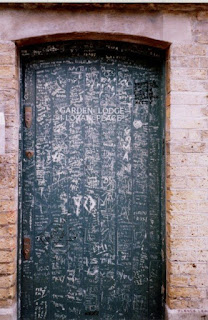
Elle leaves Freddie Mercury a message at Garden Lodge, June 2005
Because it is the anniversary of the death of one, Freddie Mercury, I decided to post some of my favourite Queen rarities. Ever since I was 8 years old, I have considered Freddie to be my first and favourite. I will always adore his dynamic personality, presence and stage performance. I will always swoon at his persistence, drive and passion.. and needless to say I will always wish for his creativity, musical skill and integrity. He's quite the benchmark to have. But unfortunately it means ma other bands miss out on ridiculous lashings of love, because quite frankly, they suck in comparison. Queen - Mad the Swine (Recorded for Queen I, 1973) (currently offline) This song was recorded (and rejected) for Queen's first album, simply entitled Queen I (1973). This song was the one of their first biblical songs, along with Jesus . Many of the band's early tracks such as My Fairy Queen, Great King Rat, Ogre Battle and The Fairy Feller's Master Stroke feature mythological scenes with lush language and imagery. The band and their producer Roy Thomas Baker couldn't agree on "the quality of percussion" so the song was consequently left off the album altogether. This later reappeared as a b-side to the single Headlong. Queen - Rock'n'Roll Medley (Live at the Hammersmith Odeon, 1975) The moment Freddie emerges in a kimono you know you're in for something so wonderfully over-the-top. The moment he disrobes you're not quite sure what to expect, but it's well worth if it you decide to uncover your eyes. Queen - The Prophet Song (Live in Osaka, 1976) (currently offline) Penned by Brian May for the epic, A Night at the Opera, The Prophet Song can broadly be described as an 8 minute biblical manifesto about Noah's Ark. This was the last song that Queen recorded that used mythological or biblical imagery. Many, including myself, consider this to be the finest composition of Brian's career, rivalling Bohemian Rhapsody in its complex production and technical brilliance. Aspects of the live performance of the Prophet Song are improvised each night, but basically The Prophet Song is promptly doused with delay and echo effects, consequently producing an atmospheric and immense Freddie choir. This particular performance, recorded nine years before my birthdate on my birthday, is nothing less than spectacular. Plus it features thousands of screaming, hysterical fangirls and nothing less than a Frère Jacques musical reference. How can you not love? Queen - You Take My Breath Away (Live at Earl's Court, 1977) Taken from their 1976 album, A Day at the Races, the live performance of You Take My Breath Away can only be described as the single most beautifully touching live moment. There is a moment when the mood is lost when there is an incidental drum crash in the middle of it. But the sentiments are not disturbed.... why do you not believe me?? Queen - It's Late (Alan Freeman Session, 1977) (currently offline) Queen's album sessions are always difficult to come by. Although more have progressively emerged thanks to sites such as Queenzone.com, I believe that we have access to only a fraction of the material recorded. Luckily, some people have looked at their own recordings of old radio shows and found a wealth of material - such as this gem from Alan Freeman's BBC Radio One Rock Show. The band chose a number of tracks from their 1977 album, News of the World such as We Will Rock You, Spread Your Wings, My Melancholy Blues and my favourite track, It's Late. They are hardly album sessions but they are the closest we are going to get.. for a while yet! So there you have it! My favourite Queen rarities, pre-moustachio years. Thanks extend to El Blog de Queen, Queenzone and Qfriends all around, who still love and miss Freddie.