Showing posts with label Authenticity. Show all posts

Sunday, January 08, 2023

"Crafted music negates genuine emotion..." I flip through my notebook to see who said this. John Lydon of the Sex Pistols. Ah.

It reminds me of an interaction that happened in 1977, down the road at Wessex Sound Studios in Islington. Queen were recording News of the World when the Sex Pistols' bassist, Sid Vicious stumbled in and said, "So, you bringing ballet to the masses then, Fred?", to which Freddie replied, "Ah Simon Ferocious! We're trying our best, dear..."  

It's a story that's been told so many times that the tone of the encounter varies from the playful to the menacing. Sometimes Simon Ferocious is Stanley Ferocious, sometimes Freddie mocks the safety pins on Sid's jacket. In some versions, Sid steps up: "So what you gonna do about it?". Freddie then grabs him by the collar and throws him out of the control room.

Queen may have been the less authentic group, according to John Lydon's exacting standards, but Freddie, the delicate underdog, had won this time... 

It would appear that they're two groups in musical opposition, both in class and in style, but it's more complicated than that. Queen delve into different musical genres and place unsuspecting songs side by side, even exploring punk at one stage. Their efforts never felt cod or inauthentic, Brian breaks a guitar string from all the thrashing, live in Paris 1979. Freddie even knocks over a speaker stack.

"Genuine emotion" doesn't mean much when you look at Queen's lyrics and see how the emotional and the analytical sit side by side. I don't think anyone has really analysed that in Queen's lyrics before, how they describe what you should feel (pietas) compared to what you do you feel (furor). They're good at those contrasts, how for every heavy song, there is a frothy and frivolous romp. The meaningless sits alongside the meaningful. It makes for interesting listening, but it's hard to convey to mansplainers.

Those contrasts and contradictions are a part of me, somehow. They play into my humour and sensibility, my desire for high culture to mix with the low. It all reminds me of a story from when I approached a group of punks hanging out by the play equipment in Burnham Park. I was five at the time, but I was compelled to ask them, "Do you like ballet?", they were bemused and gushed back at me, "Oh yeah, we love ballet!"

I was thrilled. Finally, I had found some kindred spirits.

My guess is I'm in for a cloudy and overcast

Cassettes & Chocolate Milk: 1980s Australian Podcast #67
Boom Crash Opera - Great Wall
Australian Crawl - White Limbo
INXS - Black and White (Extended Mix)
The Models - I Hear Motion
Midnight Oil - Sleep
James Reyne - Fall of Rome
Darryl Braithwaite - One Summer
Split Enz - Doctor Love

Download (93.5 MB)

Explore C&CM Podcasts 1-66 here

Thursday, July 29, 2021

 "The listener memorises a performance as a revelation, a phenomenon, while the artist only terms of skill and sound." - Mateusz Torzecki and Łukasz Słoński

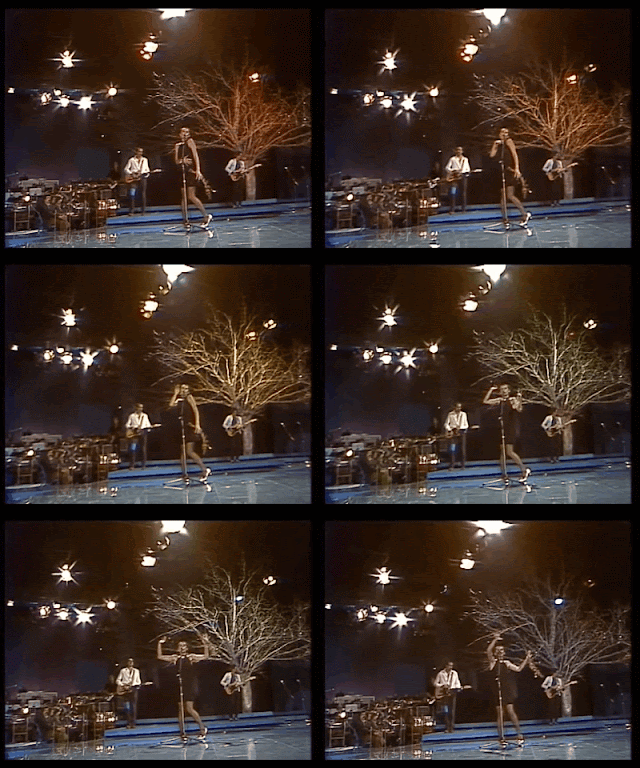
This line appeared in a chapter about female performers in the 1980s Polish rock scene. It was specifically about Kora, the lead singer of Maanam, one of the bigger groups of the era. It followed visceral descriptions of their performance at the Opole Festival in 1981. Witnesses described how Kora sang with such confidence that it completely redefined how local punk musicians should act and present themselves. Comments on YouTube would reinforce the idea of this performance as a complete revelation, and they would all be balanced by Kora's own assessment of the show: "The sound was terrible but more to the point, I just couldn't hear anything."

I watched the clips and the sound is screechy and atonal, far too raucous for my sherbet-sweet tastes. A person commented how they had this song on a cassette, a friend bought it for them from a music shop in Shinjuku and they listened to it over and over again. They never thought they would be able to see this actual performance but it was here! I understood that shock and that overwhelming gratitude, seeing your "perfect song" materialising from the archives with a video you never knew existed. Suddenly, the chasm between perfect and imperfect could never seem greater than the fan and the artist's impression of their own performance.

I love the absurd idea of a career-defining performance that the performer couldn't even hear. However, I find it irksome to imagine that Kora, as a leading punk figurehead, would be preoccupied by notions of "skill and sound". It's just so crazy and neurotic, it superimposes this perfectionist attitude that clashes with basic punk ideology. I truly believe that you can tell when someone is performing from an entirely free and unconcerned state. That's what makes performances like Maanam at Opole 1981 so extraordinary. You are witnessing an artist in a supreme state of commitment to their own artistry. When you see something like that, you finally realise that perfectionist angst is for amateurs. It is more important to show up and will your art into existence.

Maanam at Opole, 1981

Cassettes & Chocolate Milk: Polish Pop Podcast #66
Papa Dance - O La La
Roxa - A ona tańczy
Maanam - Lipstick on the Glass
Tilt - Mówię Ci że
Kapitan Nemo - Twoja Lorelei
Andrzej Zaucha - Byłaś serca biciem
Papa Dance - Czy ty lubisz to co ja
Ex Dance - Powrót Donalda

Download (73.2 MB)

Explore C&CM Podcasts 1-65 here

Wednesday, February 04, 2015

The proposition for the RPM Challenge seemed simple enough: for the month of February, you are to write and record ten songs and/or 35 minutes of music. In other words, your album. The creators likened the challenge to a kind of musical NaNoWriMo, where participants are required to write a 50,000+ word novel in the space of 30 days. In both scenarios, the idea is daunting but doable. Even if you failed to accomplish the task at hand, you would still hopefully emerge with some creative work that you wouldn't have attempted otherwise. This positive reasoning does little to beat the ongoing sense of resistance and confusion as to why they had to choose the shortest month of the year to do this.

I'm no stranger to the idea of establishing creative parameters. Paul Weller discussed it himself during his episode of The Mastertapes, locking himself up in an office, attempting to churn out tracks for the 1982 Jam album, The Gift. Perhaps the idea of working to a deadline diminishes from the romance of the creative process, but it's intriguing how quickly the mind can generate ideas with such firmly set limitations. It needn't be time restrictions either, you might only need a single word that resonates with you and if you allow yourself to take a few moments to explore the concept, something will invariably emerge. Using the methodology of Julia Cameron and Natalie Goldberg, it's necessary to write fast, write without thinking and block out the voice that says you cannot do this.

Both these challenges draw upon this compounded appeal of not only being creative, but also being prolific. It carries this implicit hope that you've managed to sort out your doubts, motivations and work in an almost mechanised fashion. It's entirely possible, you need only to listen to the impressive claim of Severo Lombardoni, the producer of the iconic Italo Disco label, Discomagic: "My setup allowed me to produce 50-60 albums a month. I even did 5-6 albums a day!" We're talking about pop music that was manufactured on the largest scale imaginable, but the sheer breadth of its catalogue does little to detract from its creative merit. It's much like an archaeological dig, where people are still searching and uncovering this music, they're making mixes and dance tracks. Their love of it is ultimately inspiring a new musical culture.

I'm drawn to analysing the nature of creativity, but I know for some that understanding creativity spoils the magic somehow. I'm often reminded of Joe Strummer's remark to Melody Maker's Caroline Coon: "If I told you how I write, when I next do it, my words will haunt me and destroy me completely..." There was a process, there must have been, yet the artist's reluctance to discuss it makes the music-making process even more mystical than it probably should be. I'm also wary of the fact that a lengthy dissection of the music-making process can be an act of procrastination. After all, it is much easier to get fired up by a TED Talk than to go through the grief of picking up a guitar and actually working out a new song.

If anyone else were to ask me whether they should take part in the RPM Challenge, I would say "Do it, create, because it's the most important thing." I'd be sure to add the words of a fellow singer who recently said to me, "Your work only exists because of you." I'm yet to fully appreciate why those words reassured me as they did, but it somehow goes to the heart of what it means to honour your ideas and will them to existence. Sure, there may be some vain component in the whole creative process, there may exist some hope that someone else will connect with your work, free of obligation or personal association. Yet, I maintain that it's the most important thing because you can never truly appreciate the breadth of your influence. Create, because you will ultimately inspire others to create.

Behind the scenes of Ratcat's That Ain't Band videoclip (via)

Cassettes & Chocolate Milk: Mod Podcast #62
Au Pairs - You
Screaming Tribesmen - Ice
Ratcat - Skin
Spivs - Boys of Desillusion
Rotjoch - Too Many Weirdos
Ricky and the Teendreams - Alison, Please
Mood Six - Memories
Uncanny X-Men - I Wanna Be Your Baby
Gyllene Tider - Tuff Tuff Tuff (Som Ett Lokomotiv)
Various Artists - She's a Machine

Download (51.6 MB)

Wednesday, August 13, 2014

The title of the book was enough to capture my attention, A Scene in Between: Tripping Through the Fashions of UK Indie Music 1980-1988. Upon its arrival at my house, I poured over every matte-print photograph of stylish yet seemingly anonymous musicians. They'd sport black and white horizontal striped shirts, drain-pipe jeans and scruffed-up Chelsea boots. Their heavy, hollow-bodied guitars would crumple billowy shirts, anoraks and duffle coats. The girls would accessorise familiar '50s polka-dot dresses with matching linen belts. Everyone would pose awkwardly on crumbling grey streets, they would play self-consciously on stages in pine-clad rec-halls among friends. It was all reminiscent of the life I had always wanted and the style I sought to revive... and then I saw this photograph of the Swansea band, The Pooh Sticks.

So Wylde

The photograph was the most sublime combination of style and inconvenience I had ever seen. Without hesitation I made it my Facebook profile picture, never stopping to consider whether anybody would appreciate what was so cool about it. Much of my fascination had to do with the fact that I've maintained a fringe for the best part of eight years and for me, fringe trims have always been an ordeal. Every six weeks, my obscured eyesight would remind me of my ongoing obligation and they were almost always poorly executed endeavours. Sure, it's a minor operation, cutting ten centimetres of hair across my face in a straight line but it usually results with stray strands and a mystifying jump in length over my left eyebrow. A slapdash hairdresser would brush me off, both physically and literally: "It's just your hair!" and I would have to stop myself from saying: "It's just one third of my freaking face!"

Aside from fringe trims, the photograph seems to fascinate me on an entirely different level. Sure, seeing, breathing and eating would be quite difficult with such a trendy aesthetic, but I love the idea of losing yourself, ultimately sacrificing your face to style. I love the idea that a person can choose anonymity, particularly in the face of cultural recognition. Identification, attribution and celebration appears to be such an integral part of the art-making process that choosing to be anonymous seems to be such a bizarre notion. Then again, it's kind of sweet to think that all you really need to know about them is contained here. You can't see their faces, sure, but you can see it in how he tilts his head, how the other holds his cigarette, how they all stand together as they do. They're the ones with attitude, with swagger. They're the ones who understood the thrill and the value of '60s garage.

I want to be in their gang.

Cassettes & Chocolate Milk: Jangle Pop Podcast #60
The Fire Engines - Big Gold Dream
Orange Juice - Falling and Laughing
The Servants - Aim in Life
The Direct Hits - Captivating Eyes
Primal Scream - May the Sun Shine Bright for You
Marine Girls - A Place in the Sun
Strawberry Switchblade - Go Away
June Brides - Heard You Whisper
Phil Wilson - 10 Miles
Talulah Gosh - Talulah Gosh

Download (48.5 MB)

Sunday, March 17, 2013

I tend to think of Adam Ant as being more dashing than articulate, but I believe he said it best in an interview with Smash Hits in June 1981: And I maintain that the audience is the most important consideration... tonight, tomorrow, next year, next century. And once you think you're "above" your audience, then I think that's the time to seriously reconsider your career. It was an idealistic proposition and one that made me overlook Mr Ant's tendency to kick in chairs and knock down tables in a restaurant in a West End town. It touched upon this nebulous idea of artist-fan requitedness: although they're singing to millions, they are humbled by the fact that you actually care.

I can see now that it would easier for the establishing artist to convey that sense of gratitude. That shock, seeing fans with placards wait at Narita Airport. That thrill, being invited to play Glastonbury for the first time. Interviews are unrehearsed, running more like therapy sessions than press conferences. Even if the establishing artist is completely convinced of their talent, there's still this unforced humility which makes you feel as if anyone can do it, if they really tried. There is always that paradox in supporting those establishing bands from the start. You so wish for their ground-breaking popularity, but your sense of ownership becomes damaged by all these other people who never seemed to care before.

We know that when an artist becomes established, a great divide is created. Although few would openly admit it, I believe we yearn for the established artist to share that nubile sense of gratitude. We know it more than anyone else, we know that commercial success is ultimately guaranteed, yet for some reason, it's vital that the artist appears to appreciate the full extent of their power and privilege. The artist can do it in an interview, like Mr Ant or even in a Grammy acceptance speech, but I find the search for artist-fan requitedness almost always comes down to the live show. It's a crafted demonstration of effort and so often, it comes down to a simple token gesture, a guitarist handing out a misshapen Dunlop Tortex plectrum to a hysterical girl in the front row. It's like they get this is a big deal...

The irony is that the sense of artist-fan requitedness would never extend to fans sympathising with the exhaustion associated with touring. We could hardly care less if the artist is playing a show every night or every other night, we could hardly care less if the artist is sick to death of playing that song. We demand that fantasy, that the performance of that song in this city is special to them, because it is special to us. In that regard, this nebulous idea of artist-fan requitedness seems to be a bit like a mutually insincere agreement to act sincere. It's important to keep up that façade, it's important to act as if everyone really cares.


Fighting over a piece of Morrissey's heart/shirt

Cassettes & Chocolate Milk: Danish Pop Podcast #55
The Raveonettes - Sleepwalking
Bodebrixen - My Name is Carl (Live)
Fallulah - Use It For Good
Northern Portrait - That's When My Headache Begins
Our Broken Garden - Garden Grow
Trentemøller - ... Even Though You're With Another Girl
The Asteroids Galaxy Tour - Around the Bend
Laban - Caught by Surprise

Download (55.4 MB)

Monday, October 10, 2011

"You wouldn't believe this conversation I had with this dude tonight. He was trying to convince me that the Kooks were more indie than the Arctic Monkeys." As soon as he said it, I couldn't help but pull an expression of bemused disgust. It was a baffling thing to consider, the prospect of an actual scale of indieness where some artists rank higher than others. The worst part of it was that I felt compelled to construct a counter-argument, citing the significance of dancingmonkey.com in the early promotion of the Arctic Monkeys. It was a site with white background and black text, featuring a list of links to MP3 demos. It appealed to the idea that the music could speak for itself and the incredible interest generated was achieved independently of record company interference. The Kooks would later post their demos onto Megaupload in early 2006, yet irrespective of the charm of Lonely Cat, the distribution of their demos could hardly be described as a significant landmark in the history of indie music.

When I regained my composure, I asked him how the actual argument unfolded. What became apparent was this person had a completely different idea of what indie meant. Once, the term indie was short for independent, encompassing groups without an affiliation with a record company (or else, groups with an affiliation with an independent record company). However, for this person, the term indie simply meant better. For me, it seemed wildly inaccurate to associate such a loaded term with a single word (and a superlative at that). But then again, I had to consider that for many, the term indie is synonymous with credibility. It is suggestive of being a lone independent artist, creating in retaliation of commercial appeal. The discernible fan, too, is required to maintain a certain degree of credibility. Cultural commentators such as Pitchfork and Flavorwire establish their own credibility by dissecting the term ruthlessly and bemoaning the idea that fashion, cynicism and laziness are killing indie music in 2011.

There are times when a faithful adherence to indie culture can go terribly wrong. The infamous viral video of "I'm Amy and I'm an Indie", from BBC Switch's Are You One of Them? is cringeworthy, to say the least. She comes across as suffering a complete lack of discernment: although she would obsessively adhere to every code associated with indie culture, she would do so without any real understanding of its significance. She would still manage to make some blunders, indulging in music in direct conflict with the indie credos, namely Razorlight and ahem, Ronan Keating. Although she is a rather innocuous 17 year old girl, it is embarrassing to watch her identifying the silly customs of a highly pretentious and highly protective subculture. It is embarrassing to watch her, because her heightened awareness of every nuance of the subculture reveals how indie kids assimilate, silently and without question.


From time to time, I arrest my desire to examine the meaning and currency of this feckless term. I occasionally give up the inclination to argue about it with friends and strangers alike. I even block out the aggressive posturings of the knowledgeable cultural guardsmen. I let all notions of competition and credibility melt away: I listen, smile and dance alone, taking in every moment of breathtaking pop.

Cassettes & Chocolate Milk: Indiepop Podcast #35
Summer Camp - Better Off WIthout You
Serenades - Birds
Andy Bull - Dog (feat. Lisa Mitchell)
General Electriks - Raid the Radio
Asobi Seksu - Thursday
CSS - Hits Me Like a Rock
Body Language - Social Studies (Plastic Plates Remix)
The Mynabirds - Let the Record Go

Download (44.6 MB)

Sunday, October 18, 2009

In putting together this week's podcast, I've been contemplating what it means to be an authentic punk. Is that label associated with some sort of a sincere engagement with that subculture? What is a sincere engagement? Who determines that, anyway? Are you an authentic punk if you slavishly adhere to the personal iconography of the movement? If you wash your hair with eggs, stick a safety pin through your nose and struggle into a pair of black drainpipe jeans, does that make you an authentic punk? It sure makes you look like other punks. Perhaps the true assessment of punk credibility is your own capacity to elucidate upon the meaning, practices and values of punk. No doubt that would involve the annoying habit of obsessively clarifying and re-clarifying the punk "status" of the same ten bands over and over again. The Jam? The Clash? The Buzzcocks? They weren't punk! The Damned? The Adverts? X-Ray Spex? They were punk!

I've been thinking about these questions in the context of my own musical identity (and the parts of it which still seem to be evolving). As a movement, punk had always intimidated me. Ever since I was five years old and I approached a bunch of third wave punks in a park in Burnham to ask if they liked ballet, I have stayed some distance away from the subculture. I had a superficial impression of what it meant to be a punk and I knew it just didn't appeal to me. Punk was designed to undermine the music of a group who had meant everything to me up to that point. Even from the outset, I knew that punk required an impossibly high level of personal engagement. I knew that I could never do it. I could never wear a swastika in the name of fashionable antagonism or mutilate myself to somehow prove my punk credibility to a rightfully skeptical Radio One DJ. I could never do it then and I could never do it now.


Pretty Vacant

So, how did it happen then? How did I get involved with punk? I can't remember exactly. It's a bit like describing how you got involved with the boy from the sketchy side of town, it's all been a bit of a haze. What I do know is that it's become a part of who I am now, in a way that I hardly feel compelled to describe or defend it. I love so much of it, even its confusing political ideologies that rarely if ever make sense. Of course, I say all this in the knowledge that I can never be an authentic punk. After all, I didn't contribute musical rants to zines like Loaded or Future Days. I didn't gob on my musical heroes at the 100 Club. I didn't harass or intimidate Chelsea pensioners at any point in time. Even if I wash my hair with egg or stick a safety pin through my nose, every attempt to be an authentic punk is thwarted by the fact that I was born half way across the world, seven years after it all officially finished.

At best, I can only ever be described as a part-time punk, an insipid poseur. Someone who plays their records very loud and pogos in their bedroom in front of their mirror (but only when their mum's gone out). It's a sad state of affairs realising you're a part of the problem. That you're a source of pain and aggravation to the righteous puritans of this musical genre. But you know what? I don't really make any apologies for it. I know that I am authentic in how I represent myself and my tastes. It's who I am and what I like and nobody has the authority to dismiss that.

Cassettes & Chocolate Milk: Mod Podcast #17
The Flys - Love and a Molotov Cocktail
The Damned - Love Song
The Nips - Nobody to Love
The Easy Cure - Just Need Myself (Demo)
The Buzzcocks - Ever Fallen in Love (With Someone You Shouldn't Have)
Patrik Fitzgerald - Safety Pin Stuck in My Heart
Various Artists - The Original Mixed Up Kid
Directors - What You Got
The Fuzztones - Bad News Travels Fast
Thee Milkshakes - For She
The Mystery Guests - Take a Look at Yourself

Download (32.1 MB)