Showing posts with label Cultural Theory. Show all posts

Thursday, February 13, 2014

I've always struggled with the concept of artistic fulfilment, I could never figure out what it was or how to get it. You could imagine that I was surprised when I came across a recipe for how to attain creative satisfaction from one of the panellists of Melvyn Bragg's In Our Time. The ingredients are really quite simple: all you need is creative control, remuneration and recognition. It's a nice thought but there are so many questions that follow this premise, all the questions involving quantity, ego and expectation. It reminds me of those local musicians who never managed to "cross over" and "make it" in other cities or countries.

To be honest with you, I have a real fascination with those musicians who were never promoted here. I am in love with those songs that I was never meant to hear. My friend Dimitri offers me this insight into what it was like to be a French child of the 1980s. He shares rare music videos, songs that many French people cannot even recall. He accompanies each song with this extraordinary understanding of its social context and critical reception. At the same time, he manages to describe the personal legacy of these songs: every song has an association.

 Muriel Moreno of Niagara

In exchange, I offer up my Australian childhood songs, awkwardly conscious of the fact that my exposure to local musical culture peaked when I was a child. I developed a liking for Ratcat, The Screaming Jets, Southern Sons and Diesel from watching Video Smash Hits. However, my exposure to local music ultimately ended when I quickly fell in love with English pop music. Throughout my twenties, there has been enormous pressure to support local music and as the pressure has intensified, my curiosity has dwindled and died out. I now live with this thought that I have purposefully ignored so much of what has been happening around me, just to indulge in this dream of living in another place, in another time.

I recall one of our last conversations, it was a cold night on Lygon Street and we were sipping these extravagant iced mochas. You were telling me of the intimate going's-on of Melbourne's 2002 Garage Rock movement. It was akin to my appreciation of London in 1977, Bristol in 1981, Milan in 1983 or Leningrad in 1984. There's this core group of tirelessly cool musicians who manage to create a community, unified by this distinctive sound and attitude. With the right sources, you can daydream about what it must have been like to be in that club, what it meant to be among the few people who understood the significance of actually being present.

"That's a good quality to have." I said, in between sips. "To be able to deconstruct an emerging scene, to recognise and define the consequence of the present. I think that's pretty special..."

Perhaps, it's not about the breadth of the acclaim, it's not about whether you're huge in Melbourne, Milan or even Mexico. When it comes to the recognition component of that artistic fulfilment recipe, I think it's about creating some kind of legacy. Whether that's in the form of a personal or cultural legacy, I think every artist has that desire to have their work placed within some sort of a context. Maybe it's up to us to create those histories, not only for our own understanding of how it all went down, but for the artist, too. We should let them know that we care, we should let them know that we've committed them to memory...

Cassettes & Chocolate Milk: French Pop Podcast #57
April March - Brainwash Part II
BB Brunes - Houna
Mai Lan - Schumacher
Exsonvaldes - L'aérotrain
Aline - Elle m'oubliera
Les Calamités - Vélomoteur
Yelle - A Cause Des Garçons
Corynne Charby - Boule de Flipper
Images - Love Emotion
Soko - I'll Kill Her

Download (56.5 MB)

Monday, July 01, 2013

In a Haze Between the Popular and Obscure...

It was a very old tweet written by Zach (@randomrecs) but it was a quip compelling enough for me to jot down and keep: Why is it that music writers only want to rehash the canonised legends or dig up the super obscure? After reading that, I felt a momentary jab of identification and it was a jab, because it was a bit painful for some untold reason. It's true, I ruminate about Queen as I seek out Форум, I dance to The Strokes as I think of Nemesy. I want to successfully articulate the consequence of those big bands that changed everything, while at the same time I long for that sense of ownership that derives from musical obscurity. So what becomes of those bands that fall between those two polarities? What are those bands that fall between those two polarities?

When it comes to music writing, I can only assume that it all comes down to a question of legacy and legitimacy. There is an unspoken expectation that we are all acquainted with Revolver and Pet Sounds, there is an assumption that we know what happened at Newport and Altamont. Documentaries, books and articles are constantly reinforcing the classic rock canon, establishing and re-establishing that familiar sense of retrospective consequence. It's nothing that I particularly resist or resent, in fact I give into it quite freely. If the University of Rochester's History of Rock Coursera course taught me nothing else, it reminded me of how comforting it is to have that shape, to have that firmly established understanding of cultural importance.

Perhaps we just like to hear the same stories over and over again. Perhaps we are shaping this history in an attempt to legitimise pop music in a way that it can stand alongside classical music. If I were really cynical, I would think the whole process of purposefully establishing musical histories reeks of insecurity: either it's the insecurity of the authority (desperately urging you that this is an artist of historical and cultural importance) or else it is the insecurity of the audience (unsure and unknowing, unclear of why they have to care for this artist exactly). But then I remember what I do on here. I just share and talk about the artists and the songs I love. I talk about the histories of various genres of music and some of those genres are obscure, so obscure that their histories haven't been properly documented yet. It's hard to describe why I love that, but the idea of uncelebrated pop fascinates me endlessly.

Why do I wish to rehash canonised legends? Because they're important to me. Why do I wish to dig up the super obscure? Because they're important to me too. Saying that, I admit that I am suspicious of the popular or that which I ought to embrace, according to some important cultural stakeholder. Perhaps those are the bands that fall between those two polarities, those contemporary groups who are not completely assured of a long-term legacy. I say that because I've witnessed that shame that comes from liking those once-popular-now-embarrassing bands. Only recently I was told of a friend-of-a-friend's deathly embarrassment, after her music press boss ridiculed her for still liking the band, Editors. It all seemed horribly ironic, since that same musical publication once campaigned heavily for that band's popularity. The incident makes me feel irked and yet, it effectively demonstrated why I'm so reluctant to take up their musical recommendations. Quite simply, I feel awkward connecting with the musically fickle.

 
Viktor Tsoi in Moscow, 1986.
 
Ideally, personal taste should be autonomous, it should remain unaffected by popular taste. There are instances where this actually happens, where you manage to develop a strong bond with the music itself, completely free of any knowledge, recommendation or hype. But whether you like it or not, every single band exists on this scale between popularity and obscurity. There will always be a historical and cultural context: Did people like their music? Did people buy their music? Is that music hard to get now? Yet what seems frustrating about it is that no matter how much we write, no matter how often we go over that historical and cultural context, there's no way of properly calibrating that scale. What might seem ridiculously obscure to one person might be more than familiar to another... and yet, oddly enough, that doesn't seem to be the point of all this.

It's about appearances. It's about establishing a sense of authority. It's about reinforcing this impression of discernment and good taste. Returning to those far-flung polarities of the very popular and the very obscure is an easy way to do that. I'm looking forward to the day when I'm more inclined to take the trickier route, to embark upon lengthy, unapologetic essays about artists who are neither popular or obscure. I wish to celebrate artists like Milli Vanilli, in a way that doesn't undermine my taste or my identity. I want to do it in a way that isn't ironic or defensive. That's a difficult thing to do, a near impossible thing to do in fact: to encourage a reader to cast aside their historical understanding of a group, to ask them to faithfully suspend their cultural pre-judgement and just listen to the music. That's something I'd really like to do.

Cassettes & Chocolate Milk: Mixed Bag Podcast #56
Internet Forever - Cover the Walls (Dreamtrak Diamond Sound)
Pompeya - Untitled
Santigold - Disparate Youth
Entrepreneurs - Fuck Tactics (feat. FOE & Ghostpoet)
Clean Bandit - A & E
Marcella Wright - Origins
Chromatics - Back from the Grave
Daniela Poggi - Break-Up (Hysteric Edit)
Veroniqué - Jungle Man
Kino - The Last Hero

Download (76.2 MB)

Sunday, March 17, 2013

I tend to think of Adam Ant as being more dashing than articulate, but I believe he said it best in an interview with Smash Hits in June 1981: And I maintain that the audience is the most important consideration... tonight, tomorrow, next year, next century. And once you think you're "above" your audience, then I think that's the time to seriously reconsider your career. It was an idealistic proposition and one that made me overlook Mr Ant's tendency to kick in chairs and knock down tables in a restaurant in a West End town. It touched upon this nebulous idea of artist-fan requitedness: although they're singing to millions, they are humbled by the fact that you actually care.

I can see now that it would easier for the establishing artist to convey that sense of gratitude. That shock, seeing fans with placards wait at Narita Airport. That thrill, being invited to play Glastonbury for the first time. Interviews are unrehearsed, running more like therapy sessions than press conferences. Even if the establishing artist is completely convinced of their talent, there's still this unforced humility which makes you feel as if anyone can do it, if they really tried. There is always that paradox in supporting those establishing bands from the start. You so wish for their ground-breaking popularity, but your sense of ownership becomes damaged by all these other people who never seemed to care before.

We know that when an artist becomes established, a great divide is created. Although few would openly admit it, I believe we yearn for the established artist to share that nubile sense of gratitude. We know it more than anyone else, we know that commercial success is ultimately guaranteed, yet for some reason, it's vital that the artist appears to appreciate the full extent of their power and privilege. The artist can do it in an interview, like Mr Ant or even in a Grammy acceptance speech, but I find the search for artist-fan requitedness almost always comes down to the live show. It's a crafted demonstration of effort and so often, it comes down to a simple token gesture, a guitarist handing out a misshapen Dunlop Tortex plectrum to a hysterical girl in the front row. It's like they get this is a big deal...

The irony is that the sense of artist-fan requitedness would never extend to fans sympathising with the exhaustion associated with touring. We could hardly care less if the artist is playing a show every night or every other night, we could hardly care less if the artist is sick to death of playing that song. We demand that fantasy, that the performance of that song in this city is special to them, because it is special to us. In that regard, this nebulous idea of artist-fan requitedness seems to be a bit like a mutually insincere agreement to act sincere. It's important to keep up that façade, it's important to act as if everyone really cares.


Fighting over a piece of Morrissey's heart/shirt

Cassettes & Chocolate Milk: Danish Pop Podcast #55
The Raveonettes - Sleepwalking
Bodebrixen - My Name is Carl (Live)
Fallulah - Use It For Good
Northern Portrait - That's When My Headache Begins
Our Broken Garden - Garden Grow
Trentemøller - ... Even Though You're With Another Girl
The Asteroids Galaxy Tour - Around the Bend
Laban - Caught by Surprise

Download (55.4 MB)

Wednesday, January 23, 2013

We had dipped out of band rehearsal one time to see another unnamed band on Smith St. My friends had warned me that the lead singer played the violin too, but not in a classical kind of way. Not even in a folky kind of way. It was a method that should have appealed to my punk sensibilities, thrashing about randomly with a desperately detuned Suzuki, but the sight of it made me grizzle and then my friend informed me: "He picked it up at a garage sale, apparently. He never bothered to learn it."

I wish I could have marvelled at the on-stage antics, as my friends did. I could have accepted the squeaks and the squawks if it served any kind of melodic purpose. Instead I looked on, feeling irked by the whole demonstration. I could see that it was a clearly an on-stage gimmick, used deliberately to highlight a kind of roughed-up credibility. He was making it clear that his parents did not fork out money for violin lessons.

I thought my issue with it had something to do with my long-established relationship with the violin, after all, I'm irrationally territorial about it at the best of times. I thought that it had something to do with the physicality of the violin itself, how its delicacy suggests that its handler has been duly taught how to handle it respectfully. It's quite unlike the guitar in that way, in that it's relatively common for guitarists to be self-taught.

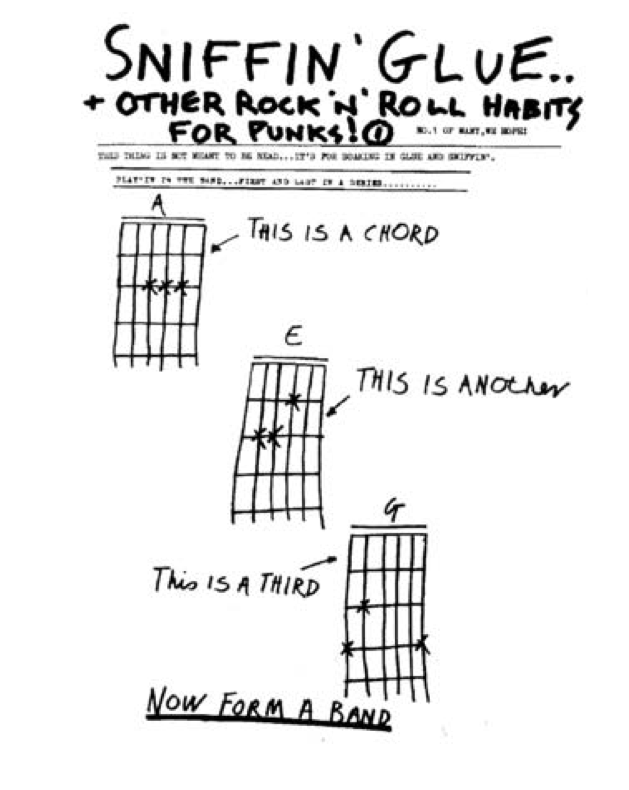
Thinking about it all now, I believe the source of my irritation really had nothing to do with the violin, itself. It didn't even have anything to do with my bourgeois expectations. If I had witnessed any performer play any instrument, from guitar to tuba, I would hope that the performer had made some small attempt to learn their instrument. I don't believe you need to be extraordinarily good, after all, I am the first to vouch my love for the Sniffin' Glue creed, This is a chord, this is another, this is a third... now form a band.

Friends, in leaving you with this week's Orchestral Pop podcast, I'm looking for your thoughts on a couple of things! Do you believe that notions of class attach themselves to certain musical instruments, but not others? Do you believe that certain instruments require professional guidance? What credibility comes from being a self-taught musician? How musically proficient do you expect your favourite musicians to be?

Ringleader

Cassettes & Chocolate Milk: Orchestral Pop Podcast #53
Depeche Mode - One Caress
Owen Pallett - Lewis Takes Action
Kishi Bashi - I Am The Anti-Christ To You
Beirut - Forks & Knives (La Fête)
Jens Lekman - Your Arms Around Me
Morrissey - I Know Very Well How I Got My Name
Agnes Kain - You Next To Me
Theoretical Girl - I Should Have Loved You More
Jem - They
Guillemots - São Paolo

Download (65.5MB)

Wednesday, January 02, 2013

I cannot exactly remember which one of us first articulated it, but there's this theory in my house that a decade only truly develops its identity 4 years in. We discovered this after living on a childhood diet of Video Smash Hits in the years spanning 1990 to 1992. It was inevitable, after such a consistent intake of Technotronic, C & C Music Factory and Snap! that we would eventually develop the ability to not only accurately characterise that musical aesthetic but to see its strong links with the late 1980s.

I can't help but be convinced that something changed in 1993, as it did in 1983 and in 1973. With specific reference to 1993, there was an obvious and growing emergence of Eurodance, Grunge and Britpop. Consequently, the 1990s managed to sever those strong stylistic links with the 1980s and somehow consolidated its own taste, style and identity. I mention all this now, because we're only days into 2013 and I'm not entirely sure how to view this decade. I'm not entirely sure how it's ever going to define itself, as other decades have managed to do.

Perhaps it is a preposterous suggestion. Surely, we will soon get a taste of what this decade is and how we will characterise it, stylistically. There are methods of measuring taste, there are charts and dancefloors, YouTube hits and Spotify. There are writers who go on about what is trendy, spouting words like "sludgecore" and "beardwave". Yet, I can't help but feel like we treat the endorsements of the established musical press with a high degree of suspicion. We download from independently run blogs to find one-off songs that are truly aligned to our taste.

I may just be looking for another Beatles, another Strokes, another Oasis, another group that manages to coincide with that dramatic re-invention of a new decade. The cynic in me is uncertain whether it's even really possible to garner up that extreme degree of popularity in a time when genres are so heavily fragmented and obscurity is king. In the case of Psy's Gangnam Style, a video receives in excess of a billion hits does not necessarily equate to a popular song, in the sense that everyone likes it. It simply means that a lot of people have seen it.

Weeks ago, I was at the Face the Music conference when I heard a woman shout out: "But no one is going to remember Gangnam Style!" It was an interesting moment, because in spite of all my reservations about this decade's identity, I knew she was wrong. It is indisputable that people will remember that song, in the very same way that we can vividly recall the irksome refrain of Eiffel 65's Blue. I have to remind myself that it is simply not possible that an era can exist without its own sense of definition.

Japanese Youth in Revolt

Even if our listening practices are totally disparate, even if nothing is as massive as it once was, I know that we will remember those songs which are truly important. I know that it will all begin to make sense with the passing of time.

Cassettes & Chocolate Milk: Indiepop Podcast #51
Health - In Heat (Javelin Remix)
Joe Goddard - Gabriel (feat. Valentina)
Chairlift - Ghost Tonight
Yeasayer - Henrietta
Foster the People - Helena Beat
daXX - RSI Megademo
Washed Out - Belong
Major Lazer - Get Free (feat. Amber of Dirty Projectors)

Download (51.2 MB)

Saturday, November 03, 2012

I have just made the most startling discovery: a vast majority of the songs I love feature the chord progression Bm G A. You may think I'm joking, but seriously, The Beat, Girl You Know It's True, Listen To Your Heart, Hate You, I've Been Thinking About You, Lost in the Night and about 70 other songs I fail to mention (but can now play on guitar) follow this musical sequence. It compels me to ask, in a style not too dissimilar to a question that may be posed by Carrie Bradshaw: Am I just falling in love with the same song over and over again?

Yes, quite possibly, but it isn't a question that particularly offends me. Sure it might get a bit awkward if you realise that you're not looking for the perfect song, you're only looking to subliminally reinforce an already-existing musical quality. This notion of subliminal reinforcement is hardly surprising within the confines of a genre such as Mod Revival or Italo Disco, where, to a new listener "everything sounds the same". What's interesting is the idea that an already-existing musical quality can transcend genre and the very thing that attracts you to Garage could be the same thing that attracts you to Eurobeat.

Perhaps it is a far-fetched theory, but I think there is definitely something in it. The phenomenon is central to the practice of those friends who have the ability to accurately predict and recommend songs I would love, with almost 100% accuracy. It's quite possible that they, too, have somehow tapped into that key and that chord progression, that sound which is going on far back in the bassline. It's a worthwhile thing to remember, when listening to the most disposable of pop or the grittiest of metal, when you strip it down to its most fundamental level, it's all the same... and to be loved, it really needs to contain Bm G A.


Cassettes & Chocolate Milk: Italo Disco Podcast #50
Costas Charitodiplomenos - Lost in the Night
Mike Rogers - Just a Story
Dyva - Leftover Love
Stage - Ocean of Crime
Radiorama - Fire
Hiroko Murata - Valentino
Kay Franzes - Shadow in the Night (Special Club Mix)
Modern Talking - Atlantis is Calling (SOS for Love)

Download (67.6 MB)