Showing posts with label Lyrics. Show all posts

Sunday, October 08, 2023

 "Now you're gone, there's nothing left to go on, to go on..."

In May 2017, I took a night bus to Ghent with the grand ambition of writing a song. I had written one just a few days before on my guitar. I had been keen to incorporate a term that we used at the hostel, so I called it Check Out. The lyrics cited the well-honed seduction techniques from our local Lothario: "Leave tonight with glow-sticks in your shoes, it's a sign you're just another conquest, just another conquest..." It only really meant something to those who were there.

The idea of songwriting tourism came about when I reflected upon one former colleague who locked herself up in an Amsterdam apartment to write an EP. I knew I couldn't do anything like that, I'm too much of a tourist to refrain from going to the castles and the op shops. I need to go to the record shops and hassle the record store owners about the local scene in the 1980s. I need to go to the clothing shops and Shazam every song. I talk to too many people. I make too many friends. No way could a song materialise from that...

I did try on that trip to Ghent though. Between the frantic tourism, I went from coffee shop to coffee shop, writing Pat Pattison-style boxes containing lyrical narratives in my flimsy cahier. Nothing materialised. It wasn't until I came upon Le Bal Infernal, a used book cafe, when something changed. I sat in the corridor, watching a silent film flicker on the creamy stone walls, probably creating a fire hazard. An inter-title flashed up and stung me: "My heart's broken. I must be alone with my thoughts." 

Making sense of your false concepts...

I ordered at the bar. I sat down with a mocha and Trust Accounts arrived.

I worked out the chords and keyed in a primitive melody on Caustic, a synthy app on my phone. I wrote lyrics down in pencil, fearing a mistake but it fell out intact. The people on the next table asked me, "What are you doing?!" I laughed. You would have thought I would feel embarrassed or annoyed but I felt totally elated. Randoms witnessed this outpouring of frantic MIDI coding and my god, I had never identified as a songwriter, but these strangers just saw me writing a song.

Certain lines of Trust Accounts felt like a Jessie Ware song to me: "Why must we act as if this is forever when love expires at the end of the night? Why must I care and hope and wish whenever you say that we can talk and share despite..." It wasn't about any one person, it was about a pattern that rolls on in perpetuity: men demanding trust in an intrusive way.

My version of Trust Accounts is not the definitive version. My friend, Marcella Wright of the synth duo Silent Income recorded a cover of it. She sends me videos of her singing it on stage in Melbourne: "Demand accounts, you can talk, you can trust me..." If it wasn't for her, Trust Accounts would have lived and died as an unheard scrappy demo, but she arranged it and transformed it, giving it this beauty and iridescence.

The lyrics still sting, but I love that. I love how it honoured, and still honours, my truth.

Cassettes & Chocolate Milk: Consequential Lyrics Fan Podcast #76
Bronski Beat - Smalltown Boy (David M. Green's VHS Revue)
Faunts - M4, Pt. 2 (Word Tweak's Substack)
Brand New - Seventy Times 7 (Jessa Stephens' My Girlfriend Dolly)
New Order - Subculture (IJ Wilson's Halloween Listening Party on FOTW Radio)
Echo and the Bunnymen - A Promise (Mark Silver's Twitter)
Sparks - Equator (Rebecca Sheedy's Mild Scribbling)
Paul Simon - The Obvious Child (Shot97's YouTube)
Belle and Sebastian - Desperation Made a Fool of Me (Teatles' Twitter)
Pink Floyd - Time (David M. Green's VHS Revue)
Bloc Party - Plans (Sharronswims' Instagram)

Download (154.2MB)

Explore C&CM Podcasts 1-75 here

More about Consequential Lyrics

Tuesday, August 08, 2023

"Tonight you'll see how love can stay here forever, when all you want is just the one last time..."

I remember how I felt when I first realised that the Hurricanes' Only One Night beared a lyrical similarity to Hot Chip's I Feel Bonnie (House Mix). I realised there was something in these songs that could be made into something, a podcast discussing parallel lyrical themes: two songs that were musically unrelated, but they used the ephemeral nature of music to enhance the meaning of the lyrics.

Both songs look at the concept pleading for "one more night", using it as an anthem for temporary lovers: "I only want one night together, in our arms, this is the only night, we're meeting arms to arms..." The lines would loop over and over again and the repetition of it echoed its madness, suggesting that despite its insistent lyrics, that one night would never be enough.

Daydreams for such projects ring out while on walks, but they're rarely meaty enough to materialise into anything real. They faintly echo the preoccupations of Consequential Lyrics, a project I did actually complete in August 2013. It involved playfully pasting up lyrics and gushing about personal meanings in episodes about Queen, The Beatles, Depeche Mode, Pet Shop Boys, The Smiths, Erasure and Roxette. There was also a fan episode, made up of contributions from musicians, writers, broadcasters, and fans.

It had to constantly remind myself that there had to be some value or even charm in recording the way people find these poetic dimensions in pop lyrics. These stories would become a precursor to the life I would lead at the hostel, sharing songs and lyrical associations with guests, late into the night. I sometimes wonder whether these lyrics were meaningful because we didn't read enough poetry, or whether we were just incapable of admitting how we truly felt.

As the hostel life moves further away from me, I wonder about those daydreams for projects that ring out. It's much like child tugging on my leather jacket, pitching ideas in vain. I'm left asking whether it's really my responsibility to do all this, to reveal personal stories with nauseating levels of vulnerability. My confidence wavers. Did I faithfully remember those lines that stung? Did I just make it all up?

Consequential Lyrics artwork by Antonio Sanciolo

Cassettes & Chocolate Milk: Consequential Lyrics Podcast #74
Fleetwood Mac - Isn't it Midnight
England Dan & John Ford Coley - I'd Really Love to See You Tonight
Sam Cooke - Desire Me
Sohn - Artifice
Nils Bech - Glimpse of Hope
Alexandra Savior - Crying All the Time
Boy Jr - Are They Actually Attractive?
Emma Pollock - If Silence Means that Much to You
Jim Croce - A Long Time Ago


Submit your voice recording of your Consequential Lyrics - quote its lyrics and expand on its meaning - for a future fan episode of C&CM. Please include the song title, personal story and relevant lyrics in your voice recording: consequentiallyrics@gmail.com

Saturday, July 08, 2023

"The pureness and simplicity must come across so people can hear the human part of the song. That is everything."

I came across that quote and I immediately thought of the bonus mini-zine that Teatles made called Beautiful Beatle Moments. It features contributions by tweet to the question: "Does anyone have a favourite moment in a Beatles song? A second or two where it all gets perfect?"

The quotes are abundant and anonymous: "The pause in the middle of She Came in Through the Bathroom Window, just before the "She said she'd always been a dancer." Each moment is spliced into a micromoment, conveyed in only a handful of words but it takes you straight to a heart-buzzing vocal take or an instrumental that makes you feel vast levels of love and gratitude. Intense emotions are cited, "John's high-pitched desperate 'pleeease' at the end of Don't Let Me Down."

In any Beatle-related conversation, it is common to bandy around the term "perfect". It's convenient for the hyperbolic gushy types like myself, but it's also helpful to convey a certain sense of gratitude that everything managed to transpire as it did. It's also helpful that to have community of people who can identify these "moving" micromoments of happiness, something barely detectable that somehow reveal the humanness, the laughter and mistakes of this band: "George fudging the solo in All You Need is Love - I know it was live. All these add to their greatness rather than detract from it."

Others run towards the raw expression and I can feel the beauty of these moments too: "Oh, how could I forget this? John baring his soul and almost sobbing the vocals, five years prior to the Plastic Ono Band album, "But it's my pride, yes it yes, yes it is, yes it is." It's beautiful to recognise something that could have been characterised as a therapeutic release, despite the evident levels of pain. We like to think we know what John had been going through and detecting these small dimensions of grief help us in some way. They help, because we miss him. It also provides a small hope that this music was cathartic for him too.

It's strange but that kind of vulnerability was mentioned only today, when I watched Paul analyse his photographs for the NPG's exhibition, Paul McCartney, Photographs 1963–64: Eyes of the Storm. Paul looked up at his photograph of John sitting in the back seat of a car, his hand folded to cover his mouth. "I forgot how he used to do that all the time..." I recognised that self-soothing gesture within myself, as a former thumb-sucker. You cover up on your month in moments of stress and you do so without even thinking about it, and then you realise you're doing it all the time.

Got to be good looking 'cause he's so hard to see

In Music and Imagination, Aaron Copland wrote about how difficult it was to seize the musical experience and hold it. "Unlike that moment in a film when a still shot suddenly immobilises a complete scene, a single musical moment immobilised makes audible only one chord, which in itself is comparatively meaningless." It might be easier to look at Paul's photograph of John and extrapolate the character of a man we feel like we know, but it's still fun to challenge Copland. We're each attempting attempt to seize the musical experience, as fleeting and granular as it is. The joy is in the attempt.

Cassettes & Chocolate Milk: Early 90s Pop Podcast #73
The Adventures of Stevie V - Dirty Cash (Money Talks) (Sold Out 7 Inch Mix)
Ace of Base - Happy Nation
Split Mirrors - The Right Time
Peter Gabriel - Digging in the Dirt
Oingo Boingo - Dream Somehow
Leevi and the Leavings - Turkmenialainen tyttöystävä
The Beloved - Time After Time
C+C Music Factory - Gonna Make You Sweat (Everybody Dance Now)

Download (87.8 MB)

Explore C&CM Podcasts 1-72 here

Tuesday, March 07, 2023

It hadn't been the most active research pursuit, but I had always willed a connection between Freddie Mercury and the V&A Museum. Perhaps it was a fanciful wish to link the two, since it's the museum I love and work for. It wasn't an implausible link either, there was that story about him taking the band to the Tate Britain to see Richard Dadd's The Fairy Feller's Master Stroke, so why wouldn't Freddie drag his friends to the V&A? I think we've all done it.

I was watching a Freddie documentary earlier this week when the anecdote I had longed for materialised. In A Life in Ten Pictures, Freddie's former girlfriend, Rosemary Pearson, spoke of their visit to the V&A together to see a ballet exhibition. It was a part of a project they had been working on at the Ealing School of Art. I had to wind it back a couple of times to see if I hadn't misheard anything. Had I found my story of Freddie at the V&A?

I looked back at the history of the V&A's exhibitions and calibrated the dates - the only ballet exhibition that could have coincided with Freddie being at the Ealing School of Art was Ballet Illustration: 1581-1940, which was on between 13 April and 1 October 1967. I checked the catalogue out at the British Library that night.

When I sat down at my desk, I wondered what on earth I expected to find exactly. Through all these elaborate set designs and elegantly drawn lithographs, there was some desire for an uncovered link, a moment that hadn't been fettered by some other fan or documentarian.

Page after page, there were smatterings of familiarity, but that was to be expected. So much of it seemed to be connected with Queen's aesthetic, whether it was sumptuous rococo stylings or the checks of the Harlequinade. I turn the page: Scharamuza. I flip back to the description: "Scaramouche brings on to the stage two small baskets, in which are concealed two small scaramouches. He then dances a measure, at the end of which he opens the baskets and is surprised to see what they contain..." Could that be the Scaramouche from Bohemian Rhapsody?

Johann Georg Puschner, Scharamuza, 1716

As I approached the end of the catalogue, towards the early 20th century designs with the Ballet Russes, I came across a costume design by Alexandra Exter from Don Juan in 1927. It was black with a band of white, asymetrically cut across the chest. The resemblance was startling, it's just like a costume Freddie wore on stage in 1972. There were slight modifications to the trousers and the right sleeve, but it looked almost the same. The influence was there and I couldn't deny it.

Alexandra Exter, Don Juan stage costume, 1927

Freddie Mercury at Imperial College, 1972

I sought out Rosemary Pearson, now known as Dr Rose Rose, and asked about her recollections about their visit. She kindly sent over her memoir, but there wasn't any detail about gallivanting through the Cast Courts, not as I had imagined it. Instead she wrote about the two of them poring over that same exhibition catalogue. She described how Freddie became entranced by its contents, crying out: "Bakst, Balanchine, Diaghilev, the names sound so delicious – so are the costumes! God, there's so much androgyny here. I'm going to swoon, DARLING! Catch me in your arms as I faint, it's all too perfect... and so CAMP!" 

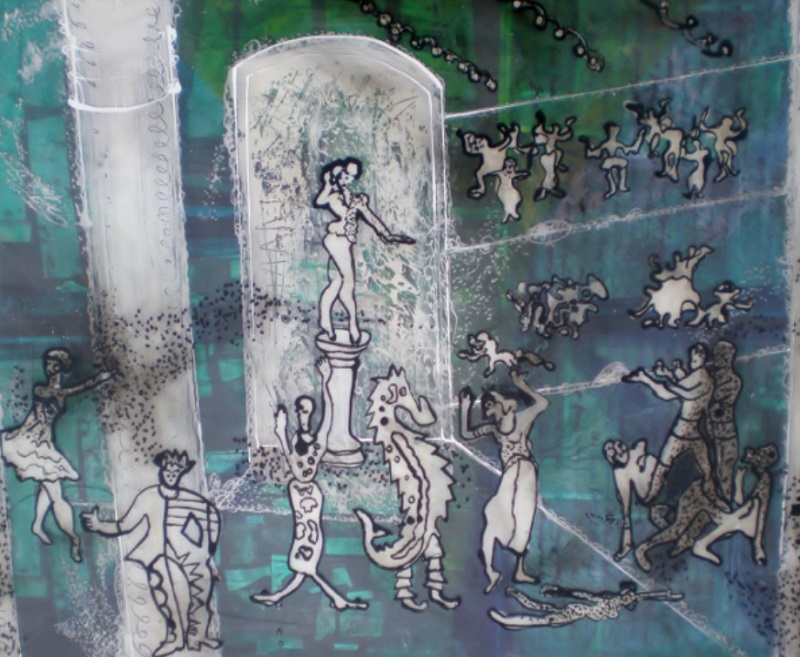
In what seemed like a living scene in the middle of the studios of the Ealing School of Art, Freddie became entranced by the costumes of Nijinsky's Scheherazade and Diaghilev's Après-Midi D'Une Faune. He pretended to pass out on the studio floor, swooning: "Dancing in that gear must have really challenged male-female boundary stuff, even in the theatre!" The chapter ends with a painting of that moment of inspiration at the Ealing School of Art, mythical figures spring to life in the middle of the studio floor.

Dr Rose Rose, Painting of "Taking inspiration from the V&A Exhibition visited with Freddie: Ballet Designs and Illustrations: 1581-1940"

In the documentary, Dr Rose Rose wrote about Freddie's fascination with Eadweard Muybridge's photographic series of two semi-nude men wrestling. In an odd coincidence, I just written about Muybridge at work. I hadn't realised this photograph represented another pang that Freddie's sexual curiosity, but there are many moments like this in the memoir. Suddenly you are very close in to this relationship filled with contradiction and nuance. 

It became very intimate, and whereas before I asked, did they even come here? I was left asking, should I even be here?

Addendum: Here is a portrait of Freddie in Rose Pearson's V&A travelling exhibition poster, Gothic Woodcarving in England. It was submitted as an end-of-year-project at the Ealing School of Art in 1969.

Cassettes & Chocolate Milk: Italo Disco Podcast #69
Vivien Vee - Americano (12")
The Creatures - Hard in the City
Retronic Voice - Deciding the End
Alter Ego - Just Like a Star
Dua Lipa - New Rules (Initial Talk 80s Rules Remix)
Den Harrow - Mad Desire
The Hurricanes - Only One Night
Vanelle - Tell Me (Radio Remix '22)
Vincenzo Salvia - Night Signs
Michael Maltese - It Isn't Changed


Sunday, January 08, 2023

"Crafted music negates genuine emotion..." I flip through my notebook to see who said this. John Lydon of the Sex Pistols. Ah.

It reminds me of an interaction that happened in 1977, down the road at Wessex Sound Studios in Islington. Queen were recording News of the World when the Sex Pistols' bassist, Sid Vicious stumbled in and said, "So, you bringing ballet to the masses then, Fred?", to which Freddie replied, "Ah Simon Ferocious! We're trying our best, dear..."  

It's a story that's been told so many times that the tone of the encounter varies from the playful to the menacing. Sometimes Simon Ferocious is Stanley Ferocious, sometimes Freddie mocks the safety pins on Sid's jacket. In some versions, Sid steps up: "So what you gonna do about it?". Freddie then grabs him by the collar and throws him out of the control room.

Queen may have been the less authentic group, according to John Lydon's exacting standards, but Freddie, the delicate underdog, had won this time... 

It would appear that they're two groups in musical opposition, both in class and in style, but it's more complicated than that. Queen delve into different musical genres and place unsuspecting songs side by side, even exploring punk at one stage. Their efforts never felt cod or inauthentic, Brian breaks a guitar string from all the thrashing, live in Paris 1979. Freddie even knocks over a speaker stack.

"Genuine emotion" doesn't mean much when you look at Queen's lyrics and see how the emotional and the analytical sit side by side. I don't think anyone has really analysed that in Queen's lyrics before, how they describe what you should feel (pietas) compared to what you do you feel (furor). They're good at those contrasts, how for every heavy song, there is a frothy and frivolous romp. The meaningless sits alongside the meaningful. It makes for interesting listening, but it's hard to convey to mansplainers.

Those contrasts and contradictions are a part of me, somehow. They play into my humour and sensibility, my desire for high culture to mix with the low. It all reminds me of a story from when I approached a group of punks hanging out by the play equipment in Burnham Park. I was five at the time, but I was compelled to ask them, "Do you like ballet?", they were bemused and gushed back at me, "Oh yeah, we love ballet!"

I was thrilled. Finally, I had found some kindred spirits.

My guess is I'm in for a cloudy and overcast

Cassettes & Chocolate Milk: 1980s Australian Podcast #67
Boom Crash Opera - Great Wall
Australian Crawl - White Limbo
INXS - Black and White (Extended Mix)
The Models - I Hear Motion
Midnight Oil - Sleep
James Reyne - Fall of Rome
Darryl Braithwaite - One Summer
Split Enz - Doctor Love

Download (93.5 MB)

Explore C&CM Podcasts 1-66 here

Sunday, March 06, 2016

The Milk Diaries: Manuscripts

Relatively early in my exploration of the Soviet post-punk band, Kino, I discovered a lyric sheet which was presumably written in the hand of the group's late singer, Viktor Tsoi. The cyrillic script was unfamiliar to me, but I liked the lined paper, the clean curvature of the print and the chord changes marked out on every second line. The most endearing part of it had to be the crosshatched sketch of a packet of cigarettes, referring to the name of the song and incidentally, one of their biggest hits.


There is an intrigue and allure in a person's handwriting, particularly in the context of these little bits of paper. They exist as score-free prompts to the songwriter, fragments with few clues referring to where this piece of paper came into the creative process. Was this jotted down in a bedroom, a hotel lobby, a studio? You come across some scribblings, crossed out lyrical alternatives that could have easily made it to session. For me, I look for clues of the songwriter's inner workings, their state of mind and the meekest suggestion that a perfect piece of pop could have immaculately conceived, free of heavy contemplation or anxiety.

I can only assume that my interest in handwriting derives from my background as a diarist. Although I have kept a diary for a little over 20 years, I only learned about stream of consciousness writing around seven years ago. The practice has allows the writer to purge thoughts and personal plagues in perfectly formed script and it's an amazing thing to see, pages and pages of work that is uncorrected and unscrutinised. The most blissful thing about it is not the analysis, as such, but the quickness of it, the simple act of your hand moving swiftly across the page.

I talk about handwritten music with my Dad a lot. He has developed this hobby of taking the messy, handwritten scores of favourite obscure operas and developing his own personal editions, comparing his interpretations with scanned rarities on IMSLP. He would tell me of the nuances of Rossini's handwriting over shelled peas and often show me clean copies of my favourite Arthur Sullivan operetta side-project, Cox and Box. In this project, it is not about interpreting the composer's state of mind, it is about clarifying his musical intention in light of the very few resources available.

Perhaps the precious thing about these musical artefacts is not the presence of handwritten mark by the hand of the songwriter or composer. I am beginning to think it is the fact that someone had the good will and foresight to preserve such documents. When Queen's archivist, Greg Brooks released a book of the band's studio jottings and lyric sheets, I was simultaneously both relieved and annoyed to see that these things existed. It was remarkable that these fragments remained, but I felt a bit jilted that they were kept from us for all that time.

Monday, September 23, 2013

Consequential Lyrics #5: The Smiths

There was a time when I enthusiastically advertised my adoration for The Smiths song, Rubber Ring. I always sure to provide that auspicious caveat that I would never outgrow the Smiths. I rebuffed those introductory lyrics: A sad fact widely known, the most impassionate song to a lonely soul is so easily outgrown. I'm certain that there were many others like me who were determined to reassure themselves that The Smiths were not just a phase, a fascination stemming from teen loneliness. Now, I can't help but view Rubber Ring as Morrissey's provocative statement, trolling the reverence of the faithful Smiths fan. To me, it's almost akin to a highly cherished (yet extremely insecure) lover baiting you in a snarl: "You'll get over me, you'll forget me when I'm gone."

Yet, in returning to The Smiths in this episode of Consequential Lyrics, I can't help but feel like there is a kernel of truth in Morrissey's prediction. It's a struggle to define exactly what I mean by that, because it is not as if I don't still love them. Their music and lyrics continue to be very important, but somehow it seems to lack that closeness it once had. I think back to when the lyrics was distressingly relevant: when loneliness, yearning and affinity seemed to be a central concern, when disastrous nights out seemed to be more prevalent. I assumed that its resonance had diminished because I don't live like that anymore. I don't think like that anymore. It's strange and it all makes me wonder whether lyrics really need to have that contemporary relevance in order to be truly consequential.

It's been suggested to me that it's not really a matter of relevance, more an issue of personal acknowledgement. For some, it can be especially difficult to acknowledge painful memories, those feelings that are recalled when we listen to songs like I Know It's Over and Please Please Please Let Me Get What I Want. The intimacy of Morrissey's lyricism can be distressing at times and the fact that these songs often take place within the adolescent bedroom serves to intensify that intimacy. It's important to have that idea of Morrissey as the adolescent fan and loner, it's important because it clearly demonstrates that he's been where "you" are now. He adores Sparks and The New York Dolls as you adore The Smiths and he gets it, he genuinely understands what it is to identify and obsess.

More than anything, it's important to preserve that idea of Morrissey as the adolescent fan and loner because eventually, he found someone that cured him: he met Johnny Marr. For my friends and I, The Smiths represented this prospect of an intensely brilliant creative partnership. We would analyse Morrissey and Marr: their oddly non-confrontational collaborative methods involving Johnny pushing a cassette tape through Morrissey's postbox, Marr's evident annoyance when he said he wrote this beautiful, rambling guitar line and then Morrissey called it Some Girls are Bigger Than Others. It was hardly an ideal partnership but you could see the love, you could see the affection in all those photographs of them together, draped over one another. We looked to them because it was the kind of connection we had always yearned for. We had always yearned for something as precious and as rare as their love for one another.

The Smiths lack that contemporary relevance because I no longer have that desire to have a Marr to my Morrissey (or a Morrissey to my Marr). I suppose that stings a little, because it was something that I had always wanted, something that I felt like I had always needed in order to be successful. I now see that intensely brilliant creative partnership is a kind of luxury, a myth that suggests a Marr could just rock up on your doorstep and fill the cracks in your head and your heart. But maybe that shift in attitude means that The Smiths are more probably relevant than they ever were, in all my years of loving them. It hurts to listen to them because they remind me of the hope I had and the hope I lost.

For we cannot cling to those old dreams anymore...

Consequential Lyrics #5: The Smiths
Rubber Ring
Pretty Girls Make Graves
How Soon is Now?
Girl Afraid
There is a Light That Never Goes Out
Please Please Please Let Me Get What I Want
Last Night I Dreamt That Somebody Loved Me
I Won't Share You

Download (59.8 MB)

Monday, September 16, 2013

Consequential Lyrics #4: Pet Shop Boys

As soon as I started thinking about the Pet Shop Boys and lyricism, my thoughts instinctively turned to the website 10 Years of Being Boring. It's a relatively old (and surprisingly vast) website that was first created in 2000 and last updated in 2003, but I have never encountered anything like it before or since. I admire its reverence and its ambition to faithfully describe the construction and consequence of this one song, a song the webmaster describes as the most beautiful song ever created.

Even before the site's advent, I knew there was always a certain sanctity that surrounded this song. I recognised it in the hand-written text which featured in the introduction of the promotional video:


It's wistful and poignant, reflecting upon friendship and loss, the passing of time and the dreams of those who are no longer with us. In an interview in 1993, Neil Tennant said that Being Boring was a personal song because it was about an old friend who had died of AIDS: "... and so it's about our lives when we were teenagers and how we moved to London, and I suppose me becoming successful and him becoming ill." According to the webmaster of 10 Years..., Being Boring was Tennant's first autobiographical song and that idea really intrigued me.

How do we properly establish that a song is autobiographical in nature? Does it need to have a certain quality, an alarming degree of personal intimacy? Surely there needs to be some specificity, a plausible link between the artist and the confession? It's always interesting when an artist freely discloses that personal consequence in an interview, as Neil did with the New Musical Express. What's fascinating, in this case, is how that act of disclosure ultimately contributed to the credibility of the Pet Shop Boys, transforming their unique brand of disco into art.

It's always so enjoyable to listen to Neil and Chris discuss their music, as demonstrated by how frequently we watch Pop Art: The Videos with their commentary. It's abundantly clear that it's all been carefully scrutinised in great detail: it's everything from the samples to the orchestration, the artwork and the imagery, not to mention, all those lyrical themes and intended meanings. It's so enormously gratifying to see how much thought went into the construction of this great music and yet, I can't quite understand why I appreciate it so much.

Perhaps a part of it has to do with the fact that so many artists just don't go into that level of detail. Whether it be obtuse lyrics or cagey artists, it's unrealistic to think the listener can always uncover a song's autobiographical relevance to the songwriter. It's a point that is so often demonstrated by friends who are musicians, who go on to confess the meaning of that song after the show is over. They add, "But I can never say that in an interview, I can never tell anyone what that song really means." I suppose that's why the autobiographical song seems so important: we want to feel as if we've been entrusted with a secret.

Consequential Lyrics #4: Pet Shop Boys
Home & Dry
Opportunities (Let's Make Lots of Money)
Can You Forgive Her?
Miracles
Always On My Mind
Numb
The Way It Used To Be
Tonight is Forever

Download (61 MB)

Monday, September 02, 2013

Consequential Lyrics #2: The Beatles

It's important to be among friends who view Beatlemania as a completely appropriate and reasonable reaction to the Beatles. In truth, my friends and I often stress to one another that if had we been at the taping of the Ed Sullivan Show or in the stands of Shea Stadium, we would have screamed (and possibly fainted) more dramatically than any of those hysterical girls on film. It's nice to acknowledge that, occasionally. It's nice to agree that the same breed of insane love manages to live on perpetually inside of us.


It's a powerful thing, that we should know all the albums, all the songs, all the lyrics, all the meanings. We know their story back to front and yet, we are still coming up with new bits of information to share with one another. I love the sheer expanse of what there is to know, the fact that they are still making radio documentaries about when The Beatles visited some little city in Wales. I love that there is an upcoming Coursera subject covering The Beatles' music. I love how it all inspires such a feeling of familiarity within us. We now speak about John, Paul, George and Ringo as if they're old friends of ours.

In making the Beatles episode of Consequential Lyrics, I wondered whether it was ever really possible to divorce a song from its historical context. After all, we have books like Ian McDonald's Revolution in the Head which document the circumstances under which every Beatles song was conceived, written and recorded. Even without the books, stories behind these songs are relatively common knowledge. What I'm curious about is whether that common knowledge affects the way we invent private meanings. Can ever really make this music ours, when we know what the artist really meant?


It's a curious term to use, ours, especially since friends have a particularly personal and purposeful approach in dealing with their musical legacy, meaning we often assigning albums and songs to one another. Saying that, for me, it's extremely unusual to take ownership of a Beatles song in a strictly emotional sense. I've only ever done that in two instances: For No One and Crying, Waiting, Hoping (which isn't even a real Beatles song, it's a Buddy Holly cover). I listen to those songs and their personal consequence seems to trump their historical context. Perhaps the associations are too painful or the official meanings are too indistinct, I'm not sure. I just know they're the only Beatles songs to take on that uniquely personal dimension.

Otherwise, these songs form an integral part of that narrative that we're constantly familiarising ourselves with. Obviously, incidental personal associations come about, lyrics often remind us of important places and moments. I've been fortunate in that many of those associations have to do with these Beatlesque-friendships, discussions with these very people who shared that insane love for the Beatles. The consequence was drawn from our fantastic imagining of the Beatles' history, but it was also drawn from this enormous relief that someone gets it: we've finally found someone who shares that intense fascination.

After I made this episode, I kept thinking about the white wall of Abbey Road Studios, crowded with messages of love. It was enchanting to see those Lennon/McCartney lyrics I loved, quotes from I've Just Seen a Face, Blackbird, The End and countless others. Why quote song lyrics? And why quote these song lyrics in particular? Perhaps it's an inscription intended to honour, ultimately designed to provoke a tug of recognition in whoever sees it. Perhaps it's a declaration of affinity, a handwritten sign that says these are my lyrics of consequence. Whatever it is, I can't help but be moved by it. Like those girls screaming in the stands, it's just a comfort that the hysteria is still going on... and it will likely continue on forever.

Consequential Lyrics #2: The Beatles
Eleanor Rigby
Don't Let Me Down
I'm Happy Just To Dance With You
You've Really Got a Hold On Me
All I've Got To Do
Wait
Anna (Go To Him)
For No One
I'm Only Sleeping
Free as a Bird

Download (52.3 MB)