Showing posts with label Freddie Mercury. Show all posts

Sunday, March 22, 2026

Introducing Visions of Rhye: Images from Freddie Mercury's Book Collection

Today I'm excited to launch Visions of Rhye: Images from Freddie Mercury's Book Collection, a digital research project exploring the visual and imaginative worlds behind Queen's earliest songs. 

Inspired by the 17 fantasy and fairy-tale books from Freddie Mercury's personal library, the project makes the illustrations of these books accessible for the first time, allowing fans, researchers, and lovers of illustration the chance to see how these texts complement Queen's first three albums. 

Homepage from Visions of Rhye: Images from Freddie Mercury's Book Collection

A screenshot of the book collection in question

A sample of some of the illustrations contained therein...


Tuesday, March 07, 2023

It hadn't been the most active research pursuit, but I had always willed a connection between Freddie Mercury and the V&A Museum. Perhaps it was a fanciful wish to link the two, since it's the museum I love and work for. It wasn't an implausible link either, there was that story about him taking the band to the Tate Britain to see Richard Dadd's The Fairy Feller's Master Stroke, so why wouldn't Freddie drag his friends to the V&A? I think we've all done it.

I was watching a Freddie documentary earlier this week when the anecdote I had longed for materialised. In A Life in Ten Pictures, Freddie's former girlfriend, Rosemary Pearson, spoke of their visit to the V&A together to see a ballet exhibition. It was a part of a project they had been working on at the Ealing School of Art. I had to wind it back a couple of times to see if I hadn't misheard anything. Had I found my story of Freddie at the V&A?

I looked back at the history of the V&A's exhibitions and calibrated the dates - the only ballet exhibition that could have coincided with Freddie being at the Ealing School of Art was Ballet Illustration: 1581-1940, which was on between 13 April and 1 October 1967. I checked the catalogue out at the British Library that night.

When I sat down at my desk, I wondered what on earth I expected to find exactly. Through all these elaborate set designs and elegantly drawn lithographs, there was some desire for an uncovered link, a moment that hadn't been fettered by some other fan or documentarian.

Page after page, there were smatterings of familiarity, but that was to be expected. So much of it seemed to be connected with Queen's aesthetic, whether it was sumptuous rococo stylings or the checks of the Harlequinade. I turn the page: Scharamuza. I flip back to the description: "Scaramouche brings on to the stage two small baskets, in which are concealed two small scaramouches. He then dances a measure, at the end of which he opens the baskets and is surprised to see what they contain..." Could that be the Scaramouche from Bohemian Rhapsody?

Johann Georg Puschner, Scharamuza, 1716

As I approached the end of the catalogue, towards the early 20th century designs with the Ballet Russes, I came across a costume design by Alexandra Exter from Don Juan in 1927. It was black with a band of white, asymetrically cut across the chest. The resemblance was startling, it's just like a costume Freddie wore on stage in 1972. There were slight modifications to the trousers and the right sleeve, but it looked almost the same. The influence was there and I couldn't deny it.

Alexandra Exter, Don Juan stage costume, 1927

Freddie Mercury at Imperial College, 1972

I sought out Rosemary Pearson, now known as Dr Rose Rose, and asked about her recollections about their visit. She kindly sent over her memoir, but there wasn't any detail about gallivanting through the Cast Courts, not as I had imagined it. Instead she wrote about the two of them poring over that same exhibition catalogue. She described how Freddie became entranced by its contents, crying out: "Bakst, Balanchine, Diaghilev, the names sound so delicious – so are the costumes! God, there's so much androgyny here. I'm going to swoon, DARLING! Catch me in your arms as I faint, it's all too perfect... and so CAMP!" 

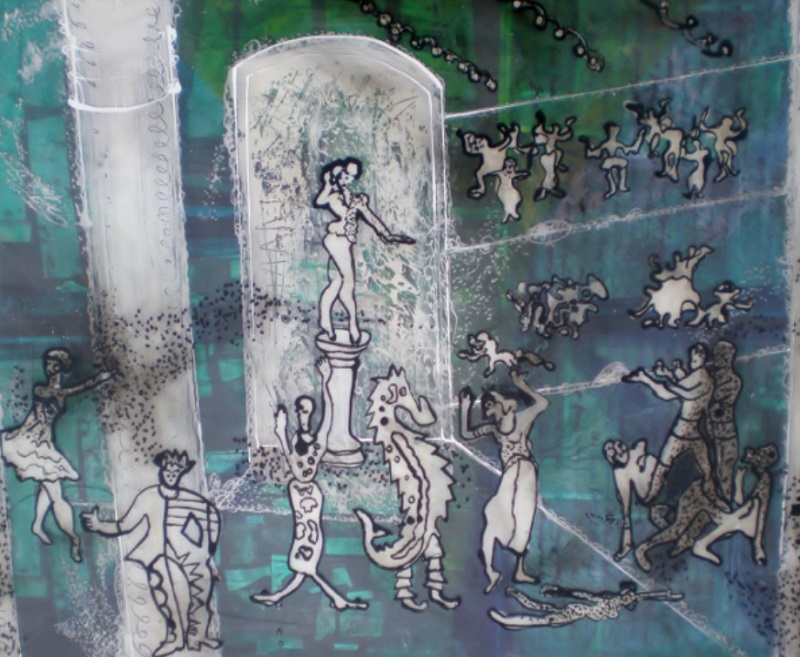
In what seemed like a living scene in the middle of the studios of the Ealing School of Art, Freddie became entranced by the costumes of Nijinsky's Scheherazade and Diaghilev's Après-Midi D'Une Faune. He pretended to pass out on the studio floor, swooning: "Dancing in that gear must have really challenged male-female boundary stuff, even in the theatre!" The chapter ends with a painting of that moment of inspiration at the Ealing School of Art, mythical figures spring to life in the middle of the studio floor.

Dr Rose Rose, Painting of "Taking inspiration from the V&A Exhibition visited with Freddie: Ballet Designs and Illustrations: 1581-1940"

In the documentary, Dr Rose Rose wrote about Freddie's fascination with Eadweard Muybridge's photographic series of two semi-nude men wrestling. In an odd coincidence, I just written about Muybridge at work. I hadn't realised this photograph represented another pang that Freddie's sexual curiosity, but there are many moments like this in the memoir. Suddenly you are very close in to this relationship filled with contradiction and nuance. 

It became very intimate, and whereas before I asked, did they even come here? I was left asking, should I even be here?

Addendum: Here is a portrait of Freddie in Rose Pearson's V&A travelling exhibition poster, Gothic Woodcarving in England. It was submitted as an end-of-year-project at the Ealing School of Art in 1969.

Cassettes & Chocolate Milk: Italo Disco Podcast #69
Vivien Vee - Americano (12")
The Creatures - Hard in the City
Retronic Voice - Deciding the End
Alter Ego - Just Like a Star
Dua Lipa - New Rules (Initial Talk 80s Rules Remix)
Den Harrow - Mad Desire
The Hurricanes - Only One Night
Vanelle - Tell Me (Radio Remix '22)
Vincenzo Salvia - Night Signs
Michael Maltese - It Isn't Changed


Wednesday, February 24, 2016

The Milk Diaries: Garden Lodge

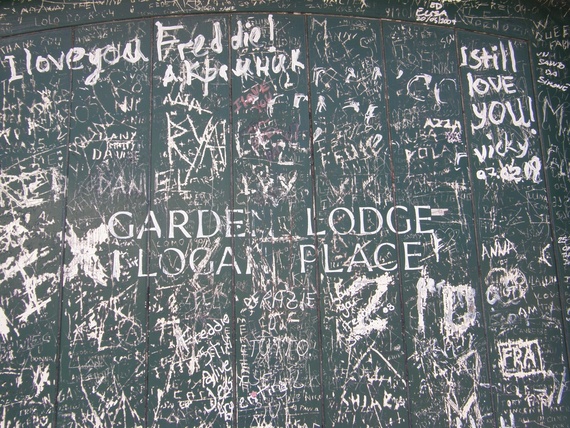
I had showed up at Freddie Mercury's home without a pen, which was OK because I found it so meditative just to read the dedications of others. Underneath the familiar serif type on that familiar green door that had been repainted over and over again, someone had written in a black sharpie, "Because you don't know what it means to me".

Freddie's door was filled with lyrical references, but I had never seen Love of My Life reframed in such a way. It seemed to sum up the powerlessness of standing there, attempting to honour such a significant musical presence. In light of this dedication, each scrap of paper, each line in liquid paper seemed to echo the same sentiment: "This was so important, but no one seems to understand..."


Monday, February 24, 2014

I have always been aware that when it comes to music from another country, there's always that slightly tacky, yet romantic prospect of the musical pilgrimage. I knew this, having pined for London each day between the ages of 5 and 20. The slightly-embellished story I've always told is this: upon my return to England, the first thing I did was take the southbound District Line service to Earl's Court tube station to visit Freddie Mercury's former home at Garden Lodge. Having initially taken a bus in the wrong direction, I had time to quietly contemplate what I would inscribe on Freddie's door. Yet as I stood before that ever-familiar dark green door with its loving messages scrawled and scratched over every square centimetre, I thought: "There's no way I could possibly articulate this..."

It's an alluring idea, to think that a place can be charged with significance and you might be able to sense that. I'll always recall the story I heard on a radio documentary about John Lennon's childhood home, Mendips. Now a museum, the caretaker described one particular young Japanese tourist who visited. Initially quiet, calm and polite, upon entering John's bedroom, she threw herself onto his bed and started wailing uncontrollably. Other visitors described how moved they were to be there, they described this feeling that took over them once they entered the house. In that way, the musical pilgrimage manages to align itself with the spiritual quality of a pilgrimage in the religious sense. Perhaps if I were more intuitive or had a greater sense of imagination, I could sense an importance, as opposed to simply being informed of one.

I love to consult the pilgrimages of Pete Frame's Rockin Around Britain, simply because the extreme level of research renders the spirituality of the musical pilgrimage void. I mean, I can't anticipate that anyone would venture out to the Permawrap cling film factory in High Wycombe simply because Howard Jones once worked in the stock control department. If anything, the fact that Frame has compiled such an enormously comprehensive resource indicates that culture is being created everywhere, in cities and villages, in halls and studios, even in squares and tube stations. It's a fact, but we're not always so inclined to react to any given locality in such a drastically emotional way.

Saying that, I'll rarely miss the opportunity to embark on one of these musical adventures. Not so long ago, I was sitting in a hotel room in Milan when my brother suddenly said to me: "Wait a second. Aren't the Paninaro kids from Milan?" I rushed to the baby laptop and replayed the promotional clip of the Pet Shop Boys' Paninaro - it became apparent that we had accidentally stumbled upon a place filled with musical consequence. I read out slabs of text, describing the 1980s youth culture. They seemed so glamourous, what with their insatiable appetite for American culture, designer denim and sandwiches. "They congregated around the sandwich bars at Piazza San Babila..." It seemed clear there was no turning back now: we were on a mission to find us some Paninaro kids.

The first thing we did the next day was venture out to Piazza San Babila. There was no abundance of sandwich, indeed there was nothing to indicate that anything had ever happened there. We walked over to the subway, recognising its inclusion in the Pet Shop Boys' video. Rafts of bored business men and tourists congregated together tightly, forming a queue by the gates and spilling out into the square. As we settled down to a bottle of milk at a nearby supermarket café, I thought about the Paninaro kids, who they were and what they might have become. One of them might have been in that crowd waiting for the subway to open, but we never would have known it. Perhaps if there were a plaque or something, a token boy in appropriate vintage attire, we might have felt differently about our failed excursion.

I've found, with my recent love of Kino and Viktor Tsoi that I've developed this desire to venture off to Russia and test this whole theory about musical pilgrimages. I'd love to go to Arbat Street in Moscow and be confronted with that heavily graffitied wall in Tsoi's honour. I'd love to deal with that struggle again, that difficulty in trying to honour the beauty and the relevance of their music. I'd love to go to Club Kamchatka, the Kino museum café bar in St Petersburg that was once the boiler room of the apartment block where Tsoi worked and lived. I might not ever develop a real appreciation of what it was actually like to be in the depths of the Russian underground rock scene, what it might have been like to see a gig or source a bootleg cassette, but I appreciate that are people who attempt to create such opportunities to remember those moments we unfortunately missed the first time round.

The Tsoi Wall by Charlie Radosna


Cassettes & Chocolate Milk: Soviet Pop Podcast #58
Yury Mukhin - Humouresque
Display - Foreign Lady
Electroclub feat. Victor Saltykov - You Marry Him, Do Not Go
Kino - Your Number
Aquarium - Rock n Roll's Dead
Rodionov - Electronic Jockey (Horse Racing)
Rodionov - Baroque (Fencing)
Forum - On the Next Street
Arsenal - Festival
Aavikko - Machu Picchu

Download (50MB)

Monday, August 26, 2013

Consequential Lyrics #1: Queen

I have finally come to terms with the idea that I'll never know what Freddie Mercury meant.

I fell in love with Queen as an eight year old and Freddie Mercury still has the honour of being my most important musical influence. Given all the personal meaning I invested in his creative output, I thought that Freddie would think about it in much the same way. However, when it came to talking about his music and lyrics, Freddie was vague. And flippant. Annoyingly vague and flippant. He boasted about the disposability of his music, famously likening his songs to Bic Razors. It was an irksome message: "You listen to it, like it, discard it, then on to the next. Disposable pop."

In his earliest interviews, he spoke of the difficulty and irritation associated with lyric writing. In later interviews, he spoke of the routine nature of creativity, the analogy that struck me most was that making music was much like churning out sausages in a factory. He consistently avoided disclosing any personal meanings and associations, urging listeners to develop their own interpretations. At the same time, there was a tantalising suggestion that there was some autobiographical meaning there: "People are always asking me what my lyrics mean. Well I say what any decent poet would say if you dared ask him to analyse his work: if you see it, darling, then it's there."

I've spent a lot of time with Freddie. I've read a lot of books and listened to a lot of interviews. I have talked to a lot of people about his attitude towards lyricism and musical creativity: from musical collaborators, biographers, documentarians to representatives from Queen Productions. Some fascinating revelations came from that research, one contributor even theorised that Freddie's reluctance to disclose the nature of his creative process was due to a superstition. Apparently, he feared that if he described his working process, he would lose that ability to create... and here I imagined that he just wanted to keep it all to himself, not make his feelings conversational fodder for untrustworthy music journalists.

I was in this never-ending search for this lost sound byte, where Freddie gives up the coy bravado and reveals something consequential. I'd find flecks of honesty here and there, a re-imagining of Freddie pulling up a piano to his bed, to play melodies if inspiration ever struck during the night. Of course there's that immortal anecdote of Crazy Little Thing Called Love being composed in a tub at the Munich Hilton. It was not because it particularly affected my relationship with his music, but I just never bought his dismissive "forget this, it means nothing" routine. Given the passion and complexity of his work and the immense effort it took to create it, I fail to see how he honestly believed his music was disposable.


But perhaps it was just me, perhaps it was just me! Perhaps I had just spent so much time with this music and I had theorised about it so much that I wanted to feel as if he invested something personal in his art. There was always that possibility that he only viewed music as a money-making venture, but I was forever hopeful that he had approached it as a sentimental artist. While everybody else I talked to could accept what he said at face value, it was harder for me to accept that maybe, he just didn't care as much as I did and maybe, just maybe, I didn't know him as well as I thought I did.

Ironically enough, there was once a time when I didn't really care what Freddie thought of his own lyrics. As a teenager, I wrote wildly preposterous online essays interpreting various Queen lyrics. I employed provocative techniques to get readers enraged and engaged. I wanted them to tell me I was wrong: "That was not what Freddie meant!". For me, it was not about being right, as such, it was about motivating listeners to articulate their personal understanding of these songs. The passion and the authority with which readers spoke about his lyricism really inspired me. Even though there was no citations for any of it, I was often moved by the insight and eloquence of these people who took the time to study his music so carefully.

All those essays, that research and production work invariably led to the invention of this series. Consequential Lyrics is a project which celebrates the meanings we independently create, as lovers and listeners of pop. We are naturally pre-disposed to create personal meanings, in such a way that provides comfort, wisdom and insight. For all the songs we do love, it's rare that we get that opportunity to faithfully articulate that significance in a properly ordered way. I suppose this project as an opportunity for you to express those private meanings, to record your voice, describing the significance of those songs in such a way that it legitimises the process of personal identification.

I may never find that sound byte, that phantom interview where Freddie reveals exactly what I want him to reveal. Frustration lies in the fact that nobody really asked the right questions, not the questions I would have wanted to ask, anyway. I comfort myself at the thought that he would have extremely unimpressed at my preposterous suggestions and my tenuous theories, connecting lyrical fragments to a varied succession of internal conflicts. Yet now it doesn't even really matter, I see now that his reluctance inspired to something far more personally meaningful. Whatever his feelings were about his music, life and words, I'm grateful to him for all the love and curiosity he inspired within me.

Consequential Lyrics #1: Queen
The Night Comes Down
The Fairy Feller's Master-Stroke
The March of the Black Queen
In the Lap of the Gods (Revisited)
Spread Your Wings
The Show Must Go On

Download (53.3 MB)