Showing posts with label Creativity. Show all posts

Thursday, July 29, 2021

 "The listener memorises a performance as a revelation, a phenomenon, while the artist only terms of skill and sound." - Mateusz Torzecki and Łukasz Słoński

This line appeared in a chapter about female performers in the 1980s Polish rock scene. It was specifically about Kora, the lead singer of Maanam, one of the bigger groups of the era. It followed visceral descriptions of their performance at the Opole Festival in 1981. Witnesses described how Kora sang with such confidence that it completely redefined how local punk musicians should act and present themselves. Comments on YouTube would reinforce the idea of this performance as a complete revelation, and they would all be balanced by Kora's own assessment of the show: "The sound was terrible but more to the point, I just couldn't hear anything."

I watched the clips and the sound is screechy and atonal, far too raucous for my sherbet-sweet tastes. A person commented how they had this song on a cassette, a friend bought it for them from a music shop in Shinjuku and they listened to it over and over again. They never thought they would be able to see this actual performance but it was here! I understood that shock and that overwhelming gratitude, seeing your "perfect song" materialising from the archives with a video you never knew existed. Suddenly, the chasm between perfect and imperfect could never seem greater than the fan and the artist's impression of their own performance.

I love the absurd idea of a career-defining performance that the performer couldn't even hear. However, I find it irksome to imagine that Kora, as a leading punk figurehead, would be preoccupied by notions of "skill and sound". It's just so crazy and neurotic, it superimposes this perfectionist attitude that clashes with basic punk ideology. I truly believe that you can tell when someone is performing from an entirely free and unconcerned state. That's what makes performances like Maanam at Opole 1981 so extraordinary. You are witnessing an artist in a supreme state of commitment to their own artistry. When you see something like that, you finally realise that perfectionist angst is for amateurs. It is more important to show up and will your art into existence.
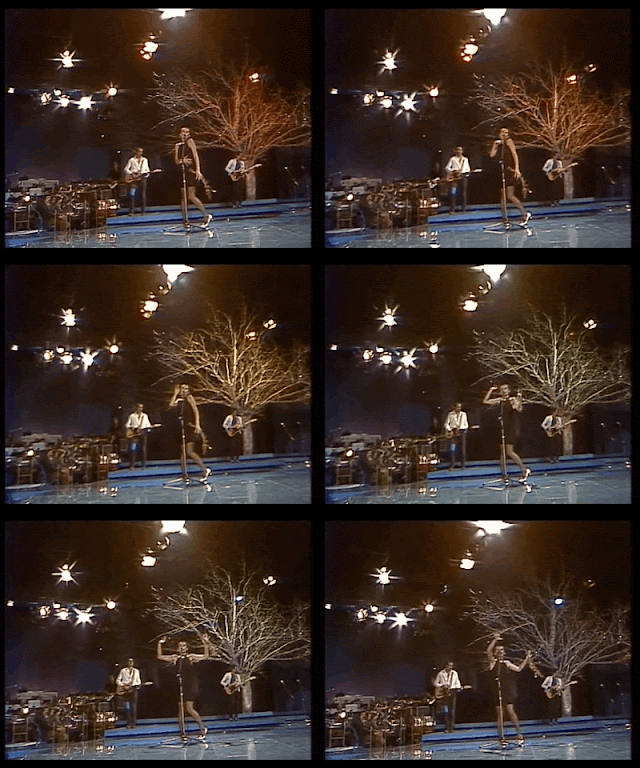
Maanam at Opole, 1981

Cassettes & Chocolate Milk: Polish Pop Podcast #66
Papa Dance - O La La
Roxa - A ona tańczy
Maanam - Lipstick on the Glass
Tilt - Mówię Ci że
Kapitan Nemo - Twoja Lorelei
Andrzej Zaucha - Byłaś serca biciem
Papa Dance - Czy ty lubisz to co ja
Ex Dance - Powrót Donalda

Download (73.2 MB)

Explore C&CM Podcasts 1-65 here

Tuesday, March 15, 2016

The Milk Diaries: Oblique Strategies

I remember it was in the great musical text, Isle of Noises: Conversations with Great British Songwriters where Ray Davies encouraged the use of unfamiliar instruments during pop composition. I think about this a lot, that when you are adept at playing an instrument, whether that be piano, guitar or violin, your fingers tend to fall back in the same places.

The idea that Ray Davies presents offers hope to those who are not particularly dexterous on their pop instrument of choice. It relies upon that theory that creative acts can actually result from technical or physical limitations. On a personal level, it warms me to think that ridiculous contortions to avoid barre chords could ultimately result in something interesting and unique.

I recall Brian May saying something similar, that he preferred to make up melodies away from the guitar as he had shared a similar tendency to return to the same, comfortable places. The concept led me to think that perhaps what is pivotal is not what you can play, but what you can imagine. It reinforced a theory I developed when I jammed with vocalist Marcella back at Casa Hawksburn.

What impressed me most was her incredible ability to instantly invent and vocalise a melody over any given loop or chord progression. It was akin to a stream of consciousness practice, where all expression is experimental, yet still thoroughly valid. The process was be inspired yet straightforward, where the memorable melodies were later developed into full tracks with synths and lush string arrangements.

On some level, these songwriters might not have a scientific understanding of their own creative process. These musicians might just be offering oblique strategies for the pop curious. Perhaps it is a naive thing to suggest such things, particularly when pop can be broken down into its most formulaic components. For me, however, there is some comfort in the idea that regardless of your musical skill, it is the trust in your first thought which might be the most inspired thing.


Wednesday, February 04, 2015

The proposition for the RPM Challenge seemed simple enough: for the month of February, you are to write and record ten songs and/or 35 minutes of music. In other words, your album. The creators likened the challenge to a kind of musical NaNoWriMo, where participants are required to write a 50,000+ word novel in the space of 30 days. In both scenarios, the idea is daunting but doable. Even if you failed to accomplish the task at hand, you would still hopefully emerge with some creative work that you wouldn't have attempted otherwise. This positive reasoning does little to beat the ongoing sense of resistance and confusion as to why they had to choose the shortest month of the year to do this.

I'm no stranger to the idea of establishing creative parameters. Paul Weller discussed it himself during his episode of The Mastertapes, locking himself up in an office, attempting to churn out tracks for the 1982 Jam album, The Gift. Perhaps the idea of working to a deadline diminishes from the romance of the creative process, but it's intriguing how quickly the mind can generate ideas with such firmly set limitations. It needn't be time restrictions either, you might only need a single word that resonates with you and if you allow yourself to take a few moments to explore the concept, something will invariably emerge. Using the methodology of Julia Cameron and Natalie Goldberg, it's necessary to write fast, write without thinking and block out the voice that says you cannot do this.

Both these challenges draw upon this compounded appeal of not only being creative, but also being prolific. It carries this implicit hope that you've managed to sort out your doubts, motivations and work in an almost mechanised fashion. It's entirely possible, you need only to listen to the impressive claim of Severo Lombardoni, the producer of the iconic Italo Disco label, Discomagic: "My setup allowed me to produce 50-60 albums a month. I even did 5-6 albums a day!" We're talking about pop music that was manufactured on the largest scale imaginable, but the sheer breadth of its catalogue does little to detract from its creative merit. It's much like an archaeological dig, where people are still searching and uncovering this music, they're making mixes and dance tracks. Their love of it is ultimately inspiring a new musical culture.

I'm drawn to analysing the nature of creativity, but I know for some that understanding creativity spoils the magic somehow. I'm often reminded of Joe Strummer's remark to Melody Maker's Caroline Coon: "If I told you how I write, when I next do it, my words will haunt me and destroy me completely..." There was a process, there must have been, yet the artist's reluctance to discuss it makes the music-making process even more mystical than it probably should be. I'm also wary of the fact that a lengthy dissection of the music-making process can be an act of procrastination. After all, it is much easier to get fired up by a TED Talk than to go through the grief of picking up a guitar and actually working out a new song.

If anyone else were to ask me whether they should take part in the RPM Challenge, I would say "Do it, create, because it's the most important thing." I'd be sure to add the words of a fellow singer who recently said to me, "Your work only exists because of you." I'm yet to fully appreciate why those words reassured me as they did, but it somehow goes to the heart of what it means to honour your ideas and will them to existence. Sure, there may be some vain component in the whole creative process, there may exist some hope that someone else will connect with your work, free of obligation or personal association. Yet, I maintain that it's the most important thing because you can never truly appreciate the breadth of your influence. Create, because you will ultimately inspire others to create.

Behind the scenes of Ratcat's That Ain't Band videoclip (via)

Cassettes & Chocolate Milk: Mod Podcast #62
Au Pairs - You
Screaming Tribesmen - Ice
Ratcat - Skin
Spivs - Boys of Desillusion
Rotjoch - Too Many Weirdos
Ricky and the Teendreams - Alison, Please
Mood Six - Memories
Uncanny X-Men - I Wanna Be Your Baby
Gyllene Tider - Tuff Tuff Tuff (Som Ett Lokomotiv)
Various Artists - She's a Machine

Download (51.6 MB)

Thursday, February 13, 2014

I've always struggled with the concept of artistic fulfilment, I could never figure out what it was or how to get it. You could imagine that I was surprised when I came across a recipe for how to attain creative satisfaction from one of the panellists of Melvyn Bragg's In Our Time. The ingredients are really quite simple: all you need is creative control, remuneration and recognition. It's a nice thought but there are so many questions that follow this premise, all the questions involving quantity, ego and expectation. It reminds me of those local musicians who never managed to "cross over" and "make it" in other cities or countries.

To be honest with you, I have a real fascination with those musicians who were never promoted here. I am in love with those songs that I was never meant to hear. My friend Dimitri offers me this insight into what it was like to be a French child of the 1980s. He shares rare music videos, songs that many French people cannot even recall. He accompanies each song with this extraordinary understanding of its social context and critical reception. At the same time, he manages to describe the personal legacy of these songs: every song has an association.

 Muriel Moreno of Niagara

In exchange, I offer up my Australian childhood songs, awkwardly conscious of the fact that my exposure to local musical culture peaked when I was a child. I developed a liking for Ratcat, The Screaming Jets, Southern Sons and Diesel from watching Video Smash Hits. However, my exposure to local music ultimately ended when I quickly fell in love with English pop music. Throughout my twenties, there has been enormous pressure to support local music and as the pressure has intensified, my curiosity has dwindled and died out. I now live with this thought that I have purposefully ignored so much of what has been happening around me, just to indulge in this dream of living in another place, in another time.

I recall one of our last conversations, it was a cold night on Lygon Street and we were sipping these extravagant iced mochas. You were telling me of the intimate going's-on of Melbourne's 2002 Garage Rock movement. It was akin to my appreciation of London in 1977, Bristol in 1981, Milan in 1983 or Leningrad in 1984. There's this core group of tirelessly cool musicians who manage to create a community, unified by this distinctive sound and attitude. With the right sources, you can daydream about what it must have been like to be in that club, what it meant to be among the few people who understood the significance of actually being present.

"That's a good quality to have." I said, in between sips. "To be able to deconstruct an emerging scene, to recognise and define the consequence of the present. I think that's pretty special..."

Perhaps, it's not about the breadth of the acclaim, it's not about whether you're huge in Melbourne, Milan or even Mexico. When it comes to the recognition component of that artistic fulfilment recipe, I think it's about creating some kind of legacy. Whether that's in the form of a personal or cultural legacy, I think every artist has that desire to have their work placed within some sort of a context. Maybe it's up to us to create those histories, not only for our own understanding of how it all went down, but for the artist, too. We should let them know that we care, we should let them know that we've committed them to memory...

Cassettes & Chocolate Milk: French Pop Podcast #57
April March - Brainwash Part II
BB Brunes - Houna
Mai Lan - Schumacher
Exsonvaldes - L'aérotrain
Aline - Elle m'oubliera
Les Calamités - Vélomoteur
Yelle - A Cause Des Garçons
Corynne Charby - Boule de Flipper
Images - Love Emotion
Soko - I'll Kill Her

Download (56.5 MB)

Monday, September 23, 2013

Consequential Lyrics #5: The Smiths

There was a time when I enthusiastically advertised my adoration for The Smiths song, Rubber Ring. I always sure to provide that auspicious caveat that I would never outgrow the Smiths. I rebuffed those introductory lyrics: A sad fact widely known, the most impassionate song to a lonely soul is so easily outgrown. I'm certain that there were many others like me who were determined to reassure themselves that The Smiths were not just a phase, a fascination stemming from teen loneliness. Now, I can't help but view Rubber Ring as Morrissey's provocative statement, trolling the reverence of the faithful Smiths fan. To me, it's almost akin to a highly cherished (yet extremely insecure) lover baiting you in a snarl: "You'll get over me, you'll forget me when I'm gone."

Yet, in returning to The Smiths in this episode of Consequential Lyrics, I can't help but feel like there is a kernel of truth in Morrissey's prediction. It's a struggle to define exactly what I mean by that, because it is not as if I don't still love them. Their music and lyrics continue to be very important, but somehow it seems to lack that closeness it once had. I think back to when the lyrics was distressingly relevant: when loneliness, yearning and affinity seemed to be a central concern, when disastrous nights out seemed to be more prevalent. I assumed that its resonance had diminished because I don't live like that anymore. I don't think like that anymore. It's strange and it all makes me wonder whether lyrics really need to have that contemporary relevance in order to be truly consequential.

It's been suggested to me that it's not really a matter of relevance, more an issue of personal acknowledgement. For some, it can be especially difficult to acknowledge painful memories, those feelings that are recalled when we listen to songs like I Know It's Over and Please Please Please Let Me Get What I Want. The intimacy of Morrissey's lyricism can be distressing at times and the fact that these songs often take place within the adolescent bedroom serves to intensify that intimacy. It's important to have that idea of Morrissey as the adolescent fan and loner, it's important because it clearly demonstrates that he's been where "you" are now. He adores Sparks and The New York Dolls as you adore The Smiths and he gets it, he genuinely understands what it is to identify and obsess.

More than anything, it's important to preserve that idea of Morrissey as the adolescent fan and loner because eventually, he found someone that cured him: he met Johnny Marr. For my friends and I, The Smiths represented this prospect of an intensely brilliant creative partnership. We would analyse Morrissey and Marr: their oddly non-confrontational collaborative methods involving Johnny pushing a cassette tape through Morrissey's postbox, Marr's evident annoyance when he said he wrote this beautiful, rambling guitar line and then Morrissey called it Some Girls are Bigger Than Others. It was hardly an ideal partnership but you could see the love, you could see the affection in all those photographs of them together, draped over one another. We looked to them because it was the kind of connection we had always yearned for. We had always yearned for something as precious and as rare as their love for one another.

The Smiths lack that contemporary relevance because I no longer have that desire to have a Marr to my Morrissey (or a Morrissey to my Marr). I suppose that stings a little, because it was something that I had always wanted, something that I felt like I had always needed in order to be successful. I now see that intensely brilliant creative partnership is a kind of luxury, a myth that suggests a Marr could just rock up on your doorstep and fill the cracks in your head and your heart. But maybe that shift in attitude means that The Smiths are more probably relevant than they ever were, in all my years of loving them. It hurts to listen to them because they remind me of the hope I had and the hope I lost.

For we cannot cling to those old dreams anymore...

Consequential Lyrics #5: The Smiths
Rubber Ring
Pretty Girls Make Graves
How Soon is Now?
Girl Afraid
There is a Light That Never Goes Out
Please Please Please Let Me Get What I Want
Last Night I Dreamt That Somebody Loved Me
I Won't Share You

Download (59.8 MB)