Showing posts with label Baroque Pop. Show all posts

Thursday, June 08, 2023

 "What would you do if you got to him?"

I had just returned from a night out at the BFI Mediathque. I meet Glynne there from time to time and we generally watch a lot of 1970s television together. Weird stuff mostly, some puzzling game shows, some awkward children's television. We had recently been preoccupied with a show called London Bridge. It was a Saturday morning TV show, designed for teenagers, made between 1974 and 1975. It's hilarious and stilted, quite often, featuring a cavalcade of stars and heartthrobs that would have made the average 70s teenager wheeze.

Calm thyself...

The distinction between adult and teenager becomes increasingly apparent when watching this show. Every segment is a kind of heavy-handed suggestion of something kids can "do" with their lives, whether that's journalism, nursing, veterinary science or acrobatics. They have a team of teenagers, sitting on the set, politely waiting their turn to ask their carefully-crafted question in a soft cockney whisper. Occasionally they are forced to step up and volunteer themselves for garish haircuts and/or makeovers by overbearing adults, often pushing weird or problematic agendas.

The sacred clapperboard

One specific episode struck me and I promptly made notes about it as soon as I came home. It was an episode where the Bay City Rollers were guests in the studio. The girls on set were especially jittery, their cheeks glowed a purplish red as they pawed nervously at their tartan scarves. They were, after all, sitting thigh by thigh with their favourite pop stars. You would have thought it would have been like any other interview, but then the bodyguards of the Bay City Rollers were introduced to the show.

The host cut to clips of the Bay City Rollers stepping out onto the tarmac, being greeted by legions of hysterical fans, just as if it were ten years before with John, Paul, George and Ringo (or maybe six months before with Freddie, Brian, Roger and John?). You couldn't help but cackle at the sheer scale of it. No offence to any Bay City Rollers fans but the hysteria seemed disproportionate to the actual handsomeness of the musicians concerned, but then, I am especially shallow and hard to please.

Rubbish

Instead of asking any questions to the fans or the group, the host looked to the band's bodyguards, questioning them about how you become a bodyguard and what it is like to travel from city to city, protecting pop musicians. The discussion turned to the rabid behaviour of the fans, throwing themselves onto cars and crying. One of the bodyguards turned to one of the girls and said, "What would you do if you got to him?" She stuttered, almost tearfully, "I don't know, I just love him..."

It was a diabolical scenario, what maniac thought this up? What would it have been like to be seated with your favourite musicians, only to be confronted by thuggish henchmen? How could you possibly account for the rabid behaviour of other teenage fans, when you're containing your lust so calmly? "What would you do if you got to him?". I wouldn't dignify that question with a response, after all, such a prompt is worthy of scrutiny only among the closest of friends, lying in the darkness on the floor of a sleepover.

Such discussions would no doubt involve detailed scenarios, dreams of what it'd be like to be face to face, hip to hip, cheek to cheek. Such admissions featured in Fred Vermorel's sociological study, Starlust: The Secret Lives of Fans. Published in 1985, the anonymity of the admissions revealed the depth, the meaning and the clarity of those daydreams. Usually, but not always, that fangirlism provided solace against the backdrop of terrible grief and loneliness.

If I could go back and advise those girls on London Bridge, I would tell them not to be rattled by those bodyguards, not to fazed by their bullish interrogation tactics. I would give them permission to obliterate their calmness and scream, scream their lungs out, just like the girls on the tarmac. They had just met their favourite band! They had just sat alongside them! Knees touching knees! Feet touching feet! This will be a day they'll remember forever. 

Cassettes & Chocolate Milk: Baroque Pop Podcast #72
Jethro Tull - Bourée
Amazing Blondel - Highwayman
Cat Stevens - Moonstone
Carpenters - Mr Guder
Paul McCartney - Dear Boy
Andrew Bird - Roma Fade
Vashti Bunyan - Come Wind Come Rain
Enya - Caribbean Blue
Lindisfarne - Lady Eleanor
Jacqueline Taieb - Ce Soir Je M'en Vais

Download (87.2 MB)

Explore C&CM Podcasts 1-71 here

Wednesday, January 23, 2013

We had dipped out of band rehearsal one time to see another unnamed band on Smith St. My friends had warned me that the lead singer played the violin too, but not in a classical kind of way. Not even in a folky kind of way. It was a method that should have appealed to my punk sensibilities, thrashing about randomly with a desperately detuned Suzuki, but the sight of it made me grizzle and then my friend informed me: "He picked it up at a garage sale, apparently. He never bothered to learn it."

I wish I could have marvelled at the on-stage antics, as my friends did. I could have accepted the squeaks and the squawks if it served any kind of melodic purpose. Instead I looked on, feeling irked by the whole demonstration. I could see that it was a clearly an on-stage gimmick, used deliberately to highlight a kind of roughed-up credibility. He was making it clear that his parents did not fork out money for violin lessons.

I thought my issue with it had something to do with my long-established relationship with the violin, after all, I'm irrationally territorial about it at the best of times. I thought that it had something to do with the physicality of the violin itself, how its delicacy suggests that its handler has been duly taught how to handle it respectfully. It's quite unlike the guitar in that way, in that it's relatively common for guitarists to be self-taught.

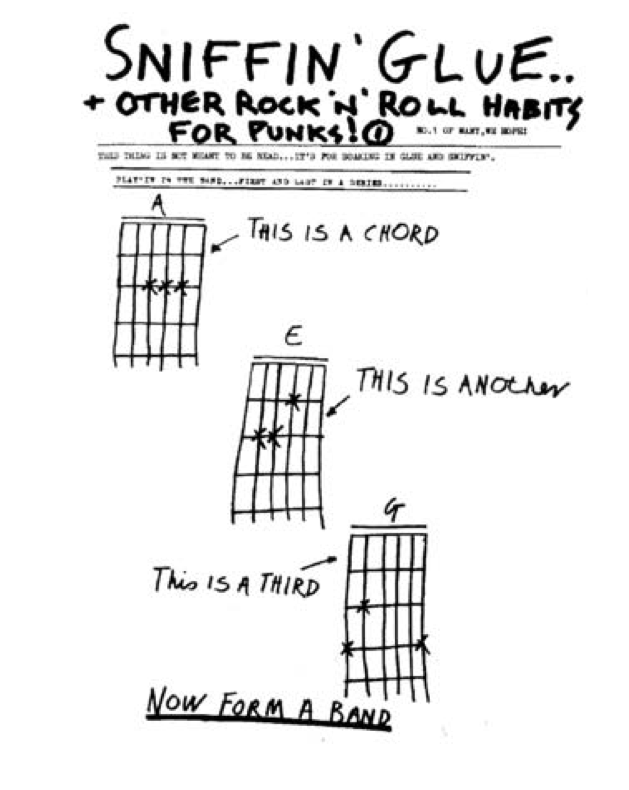
Thinking about it all now, I believe the source of my irritation really had nothing to do with the violin, itself. It didn't even have anything to do with my bourgeois expectations. If I had witnessed any performer play any instrument, from guitar to tuba, I would hope that the performer had made some small attempt to learn their instrument. I don't believe you need to be extraordinarily good, after all, I am the first to vouch my love for the Sniffin' Glue creed, This is a chord, this is another, this is a third... now form a band.

Friends, in leaving you with this week's Orchestral Pop podcast, I'm looking for your thoughts on a couple of things! Do you believe that notions of class attach themselves to certain musical instruments, but not others? Do you believe that certain instruments require professional guidance? What credibility comes from being a self-taught musician? How musically proficient do you expect your favourite musicians to be?

Ringleader

Cassettes & Chocolate Milk: Orchestral Pop Podcast #53
Depeche Mode - One Caress
Owen Pallett - Lewis Takes Action
Kishi Bashi - I Am The Anti-Christ To You
Beirut - Forks & Knives (La Fête)
Jens Lekman - Your Arms Around Me
Morrissey - I Know Very Well How I Got My Name
Agnes Kain - You Next To Me
Theoretical Girl - I Should Have Loved You More
Jem - They
Guillemots - São Paolo

Download (65.5MB)

Tuesday, January 31, 2012

I always wondered how she knew: "You haven't practiced this week..." It was never an accusation, as such. It was a statement of an undisclosed truth. Perhaps it was apparent that I struggled with unfamiliar fingering or else the passage sounded weak and uncertain. Perhaps it was both, I could never be sure. I only knew of the embarrassment I felt when I disappointed my violin teacher.

I started violin lessons with her when I was seven years old. I remember watching her walk down the front path before my first lesson. I had absolutely no understanding of what was to follow. I wish I had known, in the same way I wish I could have been a child prodigy, a three year old, naturally inclined to bang out Beethoven on the piano. But alas, it was never to be.

I still think of those early days with great affection. I was particularly fond of the rounded corn pad that was affixed to my bow, to ensure my right pinky finger was curved and in place. I also liked the yellow dots, splayed across the fingerboard in a seemingly random pattern. I struggled with some things. I was overjoyed when, after so much practice, I actually managed to pluck a string with my left pinky finger. Years later, I was dismayed to discover that this was a completely redundant skill.

I'm sure anyone who's been there knows there is too much to recall: Gussie G-String and Dora D-String, scales, arpeggios, double stops and harmonics. It would be the greatest thrill for her to affix a silver star at the top of the page, next to the title. It would be the greatest compliment for her to pencil a line across a tick, making a cross, indicating that I had mastered the piece and it was time to move on.

There was this definite sense of progression, being introduced to third position and trying to wobble my wrist in a feeble attempt to do vibrato. She'd cry out: "You're doing arm vibrato! That's so much harder to do than wrist vibrato!" I would later struggle with vibrato as a teenage violinist. As contemporaries could produce a heartfelt wobble on cue, I could only ever tense up and move my finger quickly in a small, uneven shake.

I couldn't help but feel guilty, as my teacher continued to investigate all different types of exercises and methods to help with my "vibrato problem". In all my years of playing, all my concerts, recitals, exams and lessons, I never managed to cure that glitch. Perhaps I never practised enough, perhaps my heart just wasn't in it?

But I must have loved it, didn't I? I did, I'm sure I must have. As I glean these recollections, I can't help but wish that my feelings were more resolute. That I absolutely loved everything associated with playing this instrument, that I was naturally inclined to play it and I was obsessed with it, as I am obsessed with analysing popular music. Everything could be conveniently sincere: the adoration of both instrument and teacher would be unequivocal.

When I convince myself that it was all to satisfy the whims of others, I think of Edward Elgar's Chanson de Nuit. It changed everything somehow, my phrasing, my tone, even my vibrato appeared to be more convincing. It took on the guise of being dark and isolated, much like the freedom and the loneliness that comes from staying up all night.


She insisted that everything came together with Chanson de Nuit, she declared that it was "my song". I had always hoped one song, any song would take on that dimension for me. I could never decipher the nature of my motivation to play, just as I could never determine the veracity of my affection for the instrument. Yet, I ultimately managed to pull off something that is far closer to me than any article I've written or any radio I've produced.

Cassettes & Chocolate Milk: Folk Podcast #38
The Anniversary - Sweet Marie
The Decemberists - Here I Dreamt I was an Architect
Okkervil River - Lost Coastlines
Brendan Benson - Emma J
Emma Pollock - If Silence Means That Much To You
Liam Finn - Better to Be
Wheat - I Met a Girl
The Smiths - Back to the Old House
The Raves-Ups - A Girl We All Know
Per Gessle - I Have a Party in My Head (And I Hope It Never Ends)

Download (56.6MB)

Saturday, October 23, 2010

We were sitting in a train, somewhere between Antwerp and Bruges. Perhaps it was even Bruges and Brussels, I can't even be sure. It was an unlikely situation. We sat on the fold down, dark blue vinyl chairs of the spacious baggage area. There wasn't any other place we could sit. I was thinking of important matters, namely Petit Tom and Baroque Pop. The paradox of Baroque Pop to be precise. I sat with the baby laptop on my knees and described the situation to my brother.

"You see, Baroque Pop is a paradox, because it is the pairing up of two incongruent genres. Baroque should have nothing to do with Pop."
My brother remained distracted, staring at the sleeping man sitting across from us.
"OK."
"It just doesn't make sense. I don't understand how it could have emerged, the blending of high culture and low culture. I mean, it clearly started in the mid sixties with the Left Banke, the Cake and the Kinks and so forth. It was obviously popularised by the harpsichord interlude of In My Life and who could forget Eleanor Rigby?"
He remained blank.
"Alright."

We remained silent for a few moments as I tried to develop something of a coherent argument.
"There's something in the sound. There's something about the instrumentation of Baroque Pop which makes it seem as if pop music had some kind of historical basis in classical music, when it was simply never the case."
He flinched his brow.
"It wasn't?"
I paused for a moment.
"Well, pop obviously originated from rock n roll, but that had little to do with the classical tradition."
"But some pop musicians can read music. Some." He trailed off. The man across from us slumped deeper in his chair. "I think the problem is that I don't know what you're talking about."

I pulled out my then-functioning iRiver. It was happy and intact, well before I dropped it on a tiled floor in Rome. I pressed some buttons strategically and passed him his set of headphones.
"Listen to this."
We sat in silent concentration and listened to the Kinks' Village Green. I knew he would like it, after all we both dug the harpsichord sound and ideas of a lost England. After it finished, he handed the headphones back to me.
"Maybe they used classical instruments because it just sounded nice."
I looked back at the slumped man and curled my lip in resignation.
"Maybe you're right."


Cassettes & Chocolate Milk: Baroque Pop Podcast #23
The Morning Benders - Excuses
The Kinks - Village Green
Blur - Clover Over Dover
Eddie Howell - Man from Manhattan
Split Enz - My Mistake
Jeremy Messersmith - Organ Donor
Patrick Wolf - The Libertine
The Magnetic Fields - I Don't Really Love You Anymore

Download (28 MB)