Showing posts with label Synthpop. Show all posts

Thursday, February 01, 2024

It's my third year of doing Jamuary, and it's the one occasion where I really throw myself into creating synthpop on Ableton for Brian Funk's Music Production Club. It's a big priority in my heart but I don't think about creating "real" songs, I think about the compatibilities of sound: is this too much? What am I expecting to hear? What happens if I hold back? What happens if I drop away?

I've uploaded this year's Jamuary sessions for download on C&CM. They're scrappy and DIY, and I tend to prefer the lo-fi versions on my socials. I love to detect an influence seeping in, accidentally working out how to do Italo Disco, Amiga demos, or even Bloc Party. There's a kind of thrill in creating music in such an instinctive way, working towards a sense of what "feels" right.

Hacked Playtron

My videos typically feature a Playtron, which I also call "the motherboard". It's a reworked midi controller used to trigger audio samples on Arcade's Output. The motherboard needs to be ground with a silver ring, attached by an alligator clip to my finger. Of course, this is not to be confused with the "acid harp", a lyre which overwhelms everyone with its resonance.

I might show you how the scrappy DIY jams are made one day, but perhaps that's a thing for another year (or decade)...


Wednesday, February 08, 2023

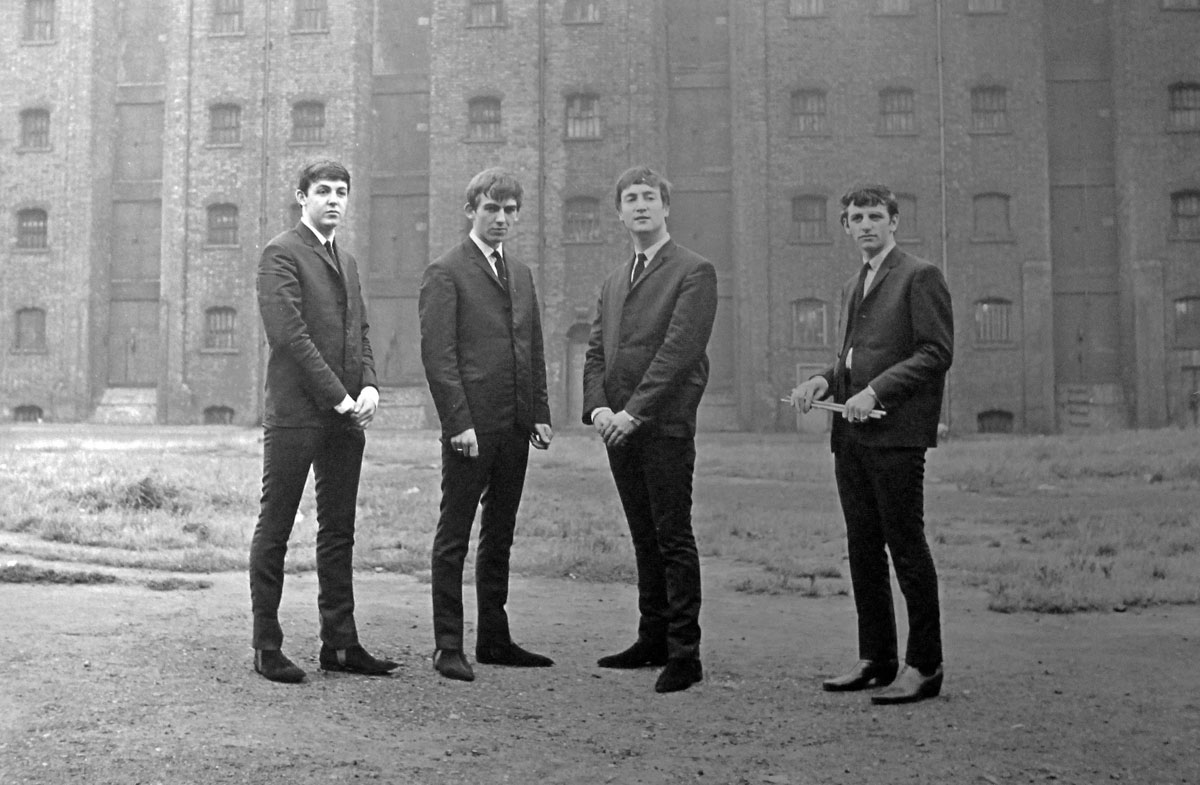
When I visit Liverpool, I'm prepared to go anywhere Teatle Huw is willing to take me, and on this occasion, it's the exterior of an abandoned tea warehouse where the Beatles once posed for a photo shoot. He furnishes the photographs of the Beatles in question, like we are gumshoe detectives familiarising ourselves with the case at hand. I don't recall ever seeing these photos before, but I clocked that it must have been early, and it was, 1962, in fact. There they stood in their suits, amongst the overgrown grass and the rubble.

The backdrop is cold and austere and were it not for the Beatles, it could be a photograph from the 1890s. There are variations of the photo at hand, in one they look more taciturn, standing several feet apart from one another, Ringo holds his drum sticks in vain, I imagine he is ready to attack if any unscrupulous characters were to approach. In another shot, they are much more lighthearted, John is mansplaining something to George, Paul is visibly cackling and it's just beautiful. Ringo looks on in amusement. You wonder what they were talking about, you wonder why they were there... 


A magical Teatle time for all...

We approach the site in question. It isn't far from the docks. We quickly realise the sightline is obstructed by the back of one-storey industrial estates on Saltney Street, so we take a closer look on Dublin Street. Teatle Huw informs me that this was not only a Beatle location, Bob Dylan came here too - his photos reveal a much more Victorian outlook, interacting with the scene and posing with street urchins. The building itself looks more dilapidated - sprigs of greenery appear from the jail bar windows and corroded copper doors. There's illegible graffiti tags, but it's a million miles from the loving inscriptions at the wall at Abbey Road Studios.

Teatle Huw takes a photo of me by the factory, allowing a sunflare to dramatically filter through. Teatle Huw would later use his stealthy Photoshop handiwork to scale himself down so he is very, very far in the background, gleefully photobombing the band. I tweet: "Today we investigated an abandoned tea factory where the Beatles made their own Teatle pilgrimage!" It's a thoroughly farcical prospect, but posing it in such a way seemed rather plausible, especially given their undeniable love of tea.

Less than a month later, I am in the audience for a preview of Mark Lewisohn's talk, Evolver '62. Late in the talk, this very photo comes up on the screen (although Teatle Huw is unfortunately omitted from the background). I hold my breath as I hear the truth behind this rare Teatle pilgrimage: it was actually a photoshoot to promote their first single, Love Me Do, which had just been released by Parlophone in October 1962. The curious thing about this photograph is that although John Lennon is actually standing in the spot where his great-grandfather James Lennon had settled with his future wife, Jane McConville. Around 1849 they had settled in Saltney Street. There, they lived in cramped squalor, where typhus, dysentery and cholera swept through the community.

But why were the Beatles there in 1962? Lewisohn said something to the effect that it looked cool, and I suppose that's reason enough to do anything. Despite the lack of tea in their real motive, the photoshoot suddenly take on a poetic dimension: The Lennons survived, this is who John became, little did he know what he was about to become...

Cassettes & Chocolate Milk: Yugowave Podcast #68
Neki to vole vruće - Teška Vremena, Prijatelju Moj
Data - Neka Ti Se Dese Prave Stvari
Oskarova Fobija - Beli Dekolte
Videosex - Videosex
Max & Intro - Beogradska Devojka
Oliver Mandic - Smejem se a plakao bih
Denis & Denis - Ja sam lazljiva
Stil - Fiks Ideja

Download (75.2 MB)

Explore C&CM Podcasts 1-67 here

Tuesday, March 01, 2016

The Milk Diaries: Denial

It was a cover Ace of Base never wanted to record, but Don't Turn Around exists as a visceral feature of their 1993 debut, The Sign (or Happy Nation, in the US). Originally recorded by Aswad in 1988, I must have listened to their synthy re-interpretation hundreds, if thousands of times since I bought it as my first CD. However, it was very only recently that it struck me why Don't Turn Around was such a potent song: its lyrics contain ineffectual statements which elude to an emotional recovery that is unlikely to take place anytime soon.

The opening line, delivered in strained spoken word says it all: "I will survive without you..." There is a synthesized rip, the kind of sound which would plausibly represent the sound of a heart being torn apart. The genius of the song does not simply exist in its instrumentation, the reggae riddim and B minor key signature, I believe it is in the lyrical treatment of vagueness and specificity, there is something heartbreaking in its depiction of both hope and denial.

Everything in the verses suggest that emotional investment is minimal: she will not campaign for reconsideration ("If you wanna leave, I won't beg you to stay"). She goes on to claim indifference about the dismantled relationship ("I won't miss your arms around me, holding me tight"). The future tense provides a clue that true recovery will take place in time ("And if you ever think about me, just know that I'll be alright"). The truth of her heartbreak is only ever revealed in the chorus:

"Don't turn around, cause you're gonna see my heart breaking,
Don't turn around, cause you're gonna see me cry,
Just walk away, it's tearing me apart that you're leaving,
I'm letting you go, but I won't let you know."

It is a devastating sentiment and you wonder whether she really does want him to turn around, to look back and acknowledge the breadth of her personal investment. It paints the portrait of a girl who attempts to regain a sense of power and composure at a time when words hold no persuasive currency. The contrast and contradiction leads us to consider whether the declaration in the chorus is designed to be an emotionally manipulative tactic or simply an explanation: please ignore the cold indifference, it is borne of grief.

Sentimentally speaking, Don't Turn Around could be aligned with Gloria Gaynor's I Will Survive. Both songs contain a succession of bold assurances of strength and goals of independence but the difference is that the confidence of I Will Survive suggests that recovery is inevitable. You don't really get that sense in Don't Turn Around, particularly since the Ace of Base version features a unique spoken word bridge from the estranged partner, declaring that pride prevents him from ever looking back.

The song remains preserved and unresolved, existing somewhere between truth and fiction forever and ever. I think that's why I need to pay heed to it. It's a perfect piece of songwriting.

Thursday, December 02, 2010

Recently, I was invited to express an opinion about "guilty pleasures". I had to chortle at the prospect of doing so, after all, I had evaluated my understanding of trashy pop music years ago. I had made a short, almost momentary radio documentary on the topic. It yielded a neverending parade of friends describing how alienated they felt by their taste. It was through talking to so many people about guilty pleasures that I realised that the shame originated from a number of sources: an acknowledgement that the music is tacky, meaningless and disposable; identifying a violently flamboyant visual aesthetic or else realising that the music conflicts with your outward persona. I also read somewhere that a guilty pleasure shows that you actually "know" about music... and there's nothing more embarrassing than knowing about music, right?

I didn't even realise that my views on such things had changed. As Mini pasted slabs of text to me, describing his love for Michelle Branch and Delta Goodrem, I noticed that he defended his passion in such a careful and sensitive way. It made me realise that guilty pleasures are simply not relevant to me anymore. I said to him, "Perhaps every thing I like is a guilty pleasure?" It is true to some extent, my cultural choices may be dismissed and ridiculed by the stealthy guardsmen of good taste. They don't even have to say anything, whoever they are. I understand what is fashionable, what is indie and credible, as opposed to what is trashy, silly and ridiculous. I was once told that there would be a time when I would not care what they thought. I was once promised that I would be comfortable and honest enough to celebrate what I love without fear of reproach.

So how did it come to be like this? I believe much of it has to do with the construction of the online identity. It is possible to conceal those things that make you uncool. You do not need to feature Milli Vanilli in your list of Favourite Artists on Facebook, you do not need to incessantly mention Ace of Base on Twitter. Instead, you can associate yourself with a kind of wispy, bearded indiepop subgenre that has considerably more gravitas and far greater kudos than Space Disco. I can't identify when it happened exactly, but somewhere between that momentary whiff of a documentary and this very day, I learned to embrace and project all that I would otherwise be ashamed of. Irrespective of any glitchy sound or cheesy attitude, I think it is the greatest thing to find that song that resonates with you. It's not fair to celebrate that discovery in isolation.

I have given up defending the music I love because I no longer take the cultural guardsman seriously. He is like an insecure hipster to me, running from one token endorsement to another. He once held such conviction in his taste, but since it has fallen out of favour with a key indie stakeholder, he feels compelled to snarl, dismiss and ridicule. He is desperate to assert his own cultural superiority, but when he does, it is almost as if he is dismissing a fragment of his musical past, a part of himself that found a rare affinity in something as beautiful and ephemeral as pop music.

It is stupid. We should never be ashamed of our taste. We should learn to trust our cultural sensibilities. Cool or otherwise, we should celebrate in rejoice in the discovery of truly great pop. That's why we're all here.


Cassettes & Chocolate Milk: Synthpop Podcast #25
Pet Shop Boys - Opportunities (Reprise)
Pet Shop Boys - Tonight is Forever
Depeche Mode - Shake the Disease
Cause & Effect - Nothing Comes to Mind
Yazoo - Nobody's Diary
Erasure - My Heart, So Blue (Orchestral Arrangement)
New Order - Dream Attack
Electronic - Vivid
The Cure - Halo

Download (54.6 MB)