Showing posts with label Musical History. Show all posts

Wednesday, February 04, 2015

The proposition for the RPM Challenge seemed simple enough: for the month of February, you are to write and record ten songs and/or 35 minutes of music. In other words, your album. The creators likened the challenge to a kind of musical NaNoWriMo, where participants are required to write a 50,000+ word novel in the space of 30 days. In both scenarios, the idea is daunting but doable. Even if you failed to accomplish the task at hand, you would still hopefully emerge with some creative work that you wouldn't have attempted otherwise. This positive reasoning does little to beat the ongoing sense of resistance and confusion as to why they had to choose the shortest month of the year to do this.

I'm no stranger to the idea of establishing creative parameters. Paul Weller discussed it himself during his episode of The Mastertapes, locking himself up in an office, attempting to churn out tracks for the 1982 Jam album, The Gift. Perhaps the idea of working to a deadline diminishes from the romance of the creative process, but it's intriguing how quickly the mind can generate ideas with such firmly set limitations. It needn't be time restrictions either, you might only need a single word that resonates with you and if you allow yourself to take a few moments to explore the concept, something will invariably emerge. Using the methodology of Julia Cameron and Natalie Goldberg, it's necessary to write fast, write without thinking and block out the voice that says you cannot do this.

Both these challenges draw upon this compounded appeal of not only being creative, but also being prolific. It carries this implicit hope that you've managed to sort out your doubts, motivations and work in an almost mechanised fashion. It's entirely possible, you need only to listen to the impressive claim of Severo Lombardoni, the producer of the iconic Italo Disco label, Discomagic: "My setup allowed me to produce 50-60 albums a month. I even did 5-6 albums a day!" We're talking about pop music that was manufactured on the largest scale imaginable, but the sheer breadth of its catalogue does little to detract from its creative merit. It's much like an archaeological dig, where people are still searching and uncovering this music, they're making mixes and dance tracks. Their love of it is ultimately inspiring a new musical culture.

I'm drawn to analysing the nature of creativity, but I know for some that understanding creativity spoils the magic somehow. I'm often reminded of Joe Strummer's remark to Melody Maker's Caroline Coon: "If I told you how I write, when I next do it, my words will haunt me and destroy me completely..." There was a process, there must have been, yet the artist's reluctance to discuss it makes the music-making process even more mystical than it probably should be. I'm also wary of the fact that a lengthy dissection of the music-making process can be an act of procrastination. After all, it is much easier to get fired up by a TED Talk than to go through the grief of picking up a guitar and actually working out a new song.

If anyone else were to ask me whether they should take part in the RPM Challenge, I would say "Do it, create, because it's the most important thing." I'd be sure to add the words of a fellow singer who recently said to me, "Your work only exists because of you." I'm yet to fully appreciate why those words reassured me as they did, but it somehow goes to the heart of what it means to honour your ideas and will them to existence. Sure, there may be some vain component in the whole creative process, there may exist some hope that someone else will connect with your work, free of obligation or personal association. Yet, I maintain that it's the most important thing because you can never truly appreciate the breadth of your influence. Create, because you will ultimately inspire others to create.

Behind the scenes of Ratcat's That Ain't Band videoclip (via)

Cassettes & Chocolate Milk: Mod Podcast #62
Au Pairs - You
Screaming Tribesmen - Ice
Ratcat - Skin
Spivs - Boys of Desillusion
Rotjoch - Too Many Weirdos
Ricky and the Teendreams - Alison, Please
Mood Six - Memories
Uncanny X-Men - I Wanna Be Your Baby
Gyllene Tider - Tuff Tuff Tuff (Som Ett Lokomotiv)
Various Artists - She's a Machine

Download (51.6 MB)

Monday, February 24, 2014

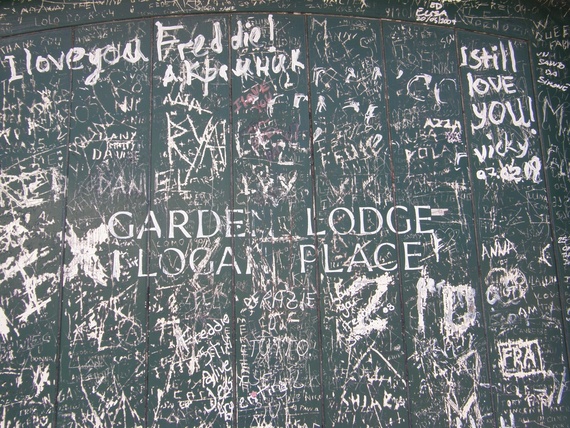
I have always been aware that when it comes to music from another country, there's always that slightly tacky, yet romantic prospect of the musical pilgrimage. I knew this, having pined for London each day between the ages of 5 and 20. The slightly-embellished story I've always told is this: upon my return to England, the first thing I did was take the southbound District Line service to Earl's Court tube station to visit Freddie Mercury's former home at Garden Lodge. Having initially taken a bus in the wrong direction, I had time to quietly contemplate what I would inscribe on Freddie's door. Yet as I stood before that ever-familiar dark green door with its loving messages scrawled and scratched over every square centimetre, I thought: "There's no way I could possibly articulate this..."

It's an alluring idea, to think that a place can be charged with significance and you might be able to sense that. I'll always recall the story I heard on a radio documentary about John Lennon's childhood home, Mendips. Now a museum, the caretaker described one particular young Japanese tourist who visited. Initially quiet, calm and polite, upon entering John's bedroom, she threw herself onto his bed and started wailing uncontrollably. Other visitors described how moved they were to be there, they described this feeling that took over them once they entered the house. In that way, the musical pilgrimage manages to align itself with the spiritual quality of a pilgrimage in the religious sense. Perhaps if I were more intuitive or had a greater sense of imagination, I could sense an importance, as opposed to simply being informed of one.

I love to consult the pilgrimages of Pete Frame's Rockin Around Britain, simply because the extreme level of research renders the spirituality of the musical pilgrimage void. I mean, I can't anticipate that anyone would venture out to the Permawrap cling film factory in High Wycombe simply because Howard Jones once worked in the stock control department. If anything, the fact that Frame has compiled such an enormously comprehensive resource indicates that culture is being created everywhere, in cities and villages, in halls and studios, even in squares and tube stations. It's a fact, but we're not always so inclined to react to any given locality in such a drastically emotional way.

Saying that, I'll rarely miss the opportunity to embark on one of these musical adventures. Not so long ago, I was sitting in a hotel room in Milan when my brother suddenly said to me: "Wait a second. Aren't the Paninaro kids from Milan?" I rushed to the baby laptop and replayed the promotional clip of the Pet Shop Boys' Paninaro - it became apparent that we had accidentally stumbled upon a place filled with musical consequence. I read out slabs of text, describing the 1980s youth culture. They seemed so glamourous, what with their insatiable appetite for American culture, designer denim and sandwiches. "They congregated around the sandwich bars at Piazza San Babila..." It seemed clear there was no turning back now: we were on a mission to find us some Paninaro kids.

The first thing we did the next day was venture out to Piazza San Babila. There was no abundance of sandwich, indeed there was nothing to indicate that anything had ever happened there. We walked over to the subway, recognising its inclusion in the Pet Shop Boys' video. Rafts of bored business men and tourists congregated together tightly, forming a queue by the gates and spilling out into the square. As we settled down to a bottle of milk at a nearby supermarket café, I thought about the Paninaro kids, who they were and what they might have become. One of them might have been in that crowd waiting for the subway to open, but we never would have known it. Perhaps if there were a plaque or something, a token boy in appropriate vintage attire, we might have felt differently about our failed excursion.

I've found, with my recent love of Kino and Viktor Tsoi that I've developed this desire to venture off to Russia and test this whole theory about musical pilgrimages. I'd love to go to Arbat Street in Moscow and be confronted with that heavily graffitied wall in Tsoi's honour. I'd love to deal with that struggle again, that difficulty in trying to honour the beauty and the relevance of their music. I'd love to go to Club Kamchatka, the Kino museum café bar in St Petersburg that was once the boiler room of the apartment block where Tsoi worked and lived. I might not ever develop a real appreciation of what it was actually like to be in the depths of the Russian underground rock scene, what it might have been like to see a gig or source a bootleg cassette, but I appreciate that are people who attempt to create such opportunities to remember those moments we unfortunately missed the first time round.

The Tsoi Wall by Charlie Radosna


Cassettes & Chocolate Milk: Soviet Pop Podcast #58
Yury Mukhin - Humouresque
Display - Foreign Lady
Electroclub feat. Victor Saltykov - You Marry Him, Do Not Go
Kino - Your Number
Aquarium - Rock n Roll's Dead
Rodionov - Electronic Jockey (Horse Racing)
Rodionov - Baroque (Fencing)
Forum - On the Next Street
Arsenal - Festival
Aavikko - Machu Picchu

Download (50MB)